


How to Improve VM Execution in Retail Stores
Visual merchandising is often managed as a uniform discipline. Audits, checklists, and compliance routines typically apply the same frequency and rigor across categories and SKUs. On the surface, this feels fair and systematic.
In reality, not all SKUs behave the same on the shop floor. High-selling, high-velocity SKUs experience far more customer interaction than slow movers, and as a result, they break down faster. Treating both categories with the same VM cadence creates blind spots that directly impact customer perception and conversion.
What the data shows about VM breakdowns
Based on our experience working with numerous retail brands across categories such as beauty, electronics, grocery, and specialty retail, VM deviations tend to follow a clear concentration pattern.
In many store networks, 30–50 percent of daily VM misses originate from a small set of high-velocity SKUs, typically among the top 50–100 items by sales volume.
| SKU group | Share of total SKUs | Share of VM misses |
| Top 10% by sales velocity | ~10% | 30–50% |
| Middle 40% | ~40% | 20–30% |
| Bottom 50% (slow movers) | ~50% | 10–20% |
This pattern repeats across campaigns and audit cycles, even though these SKUs receive the same audit frequency as slower-moving items.
While the distribution of VM misses highlights concentration, the underlying reason lies in how differently each SKU category behaves on the shop floor.
| SKU Category | Customer Interaction Level | Shelf Disturbance Frequency | VM Risk Level | Recommended VM Attention |
| Top-selling SKUs | Very high | Multiple times per day | Very high | Frequent, targeted checks |
| Mid-tier SKUs | Moderate | Daily | Medium | Standard monitoring |
| Slow-moving SKUs | Low | Infrequent | Low | Periodic checks |
This difference in shelf behavior is what makes uniform VM routines inherently inefficient.
Why high-velocity shelves break faster
High-selling SKUs sit at the center of customer activity. They are picked up more frequently, depleted faster, and re-arranged more often. Promotions, substitutions, and variant comparisons further increase shelf disturbance.
Common VM issues observed around fast movers include:
- broken facings within hours of replenishment
- misplaced variants after customer handling
- shelf gaps forming before the next refill cycle
- labels and price cards drifting out of alignment
These issues are not isolated incidents. They recur daily, often multiple times within a single store day.
How customers experience this imbalance
Customers form impressions quickly, and those impressions are shaped by the shelves they interact with most. High-selling SKUs usually sit in high-visibility, high-traffic zones.
When these shelves look cluttered, depleted, or inconsistent, customers often infer poor upkeep, even if the rest of the store is compliant. This has a measurable impact on:
- hesitation at the shelf
- lower conversion in familiar categories
- reduced add-on purchases
In contrast, VM issues in slow-moving categories tend to go unnoticed for longer periods.
What changes when SKU velocity is factored into VM checks
Retailers that begin prioritizing VM effort based on SKU velocity typically make small but meaningful adjustments, such as:
- increasing check frequency only for top-selling SKUs
- grouping fast movers into focused VM zones
- assigning quick corrective tasks during peak store hours
- allowing slower categories to be checked less frequently
Importantly, these changes do not increase workload. They redistribute attention to the shelves that degrade fastest.
How data enables this shift
To prioritize effectively, teams need visibility into:
- which SKUs trigger VM misses most often
- how quickly shelves break after correction
- whether issues are one-off or persistent
Photo-based VM validation and analytics allow teams to track this over time. Instead of treating each audit in isolation, patterns become visible across days and weeks.
For example:
| SKU | Avg. VM misses per day | Avg. time to breakdown |
| SKU A (top seller) | 3.2 | 2–3 hours |
| SKU B (top seller) | 2.7 | 3–4 hours |
| SKU C (slow mover) | 0.4 | 10–14 days |
Once this data is visible, prioritization becomes an operational decision, not a subjective one.
However, identifying these patterns is only the first step. The real challenge is ensuring that this prioritization is executed consistently at store level.
How HipHip.AI enables velocity-aware VM execution
The challenge is not knowing that high-selling SKUs need more attention. It is ensuring that this prioritization consistently happens at store level without increasing operational complexity.
HipHip.AI enables retailers to translate SKU behavior directly into execution priorities.
- Dynamic prioritization of high-impact SKUs
VM workflows adapt based on SKU velocity, ensuring that shelves with the highest customer interaction are checked more frequently than low-impact areas. - Shelf stability tracking over time
The system measures how quickly specific SKUs break after correction, helping teams understand which shelves require repeated attention within a single day. - Cross-store SKU pattern identification
Retailers can identify SKUs that consistently trigger VM issues across multiple stores, allowing central teams to address systemic issues rather than isolated store-level problems. - Real-time execution guidance for store teams
Store staff are guided toward the SKUs that matter most at that moment, ensuring effort is aligned with customer behavior instead of static routines.
The result is a shift from uniform VM execution to velocity-driven prioritization, where attention continuously follows impact.
This shift becomes clearer when applied in a real store context.
How this plays out in a live store environment
A beauty retailer identifies its top-performing SKUs across categories like skincare and cosmetics.
- These SKUs are flagged for higher VM attention
- Store teams perform quick checks during peak hours
- Photo validation confirms shelf condition multiple times a day
Within a few days, the system highlights:
- specific SKUs that break within 2–3 hours of correction
- repeated issues in high-traffic display zones
The team responds by:
- increasing micro-checks only for these SKUs
- aligning VM correction with replenishment cycles
As a result:
- shelf consistency improves in high-traffic zones
- repeat VM misses reduce significantly
- customer interaction becomes smoother without increasing workload
VM prioritization must follow shelf behavior, not fixed routines
Visual merchandising does not break evenly across the store. It breaks fastest where customer interaction is highest.
Applying the same VM cadence across all SKUs creates a structural gap, where high-impact shelves degrade faster than they are maintained.
The shift forward is not increasing effort, but realigning attention.
When retailers prioritize VM based on SKU velocity, they are able to:
- maintain consistency where customers engage the most
- reduce repeated breakdowns in high-traffic zones
- improve conversion without additional operational load
In practice, effective VM is not about uniform discipline. It is about understanding what changes fastest and responding accordingly.
High-selling SKUs experience the most wear and tear. When retailers use data to align VM prioritization with SKU velocity, small operational changes deliver outsized impact.
For retailers evaluating how data-backed VM prioritization can improve execution without increasing workload, please reach us at [email protected]
About HipHip.AI
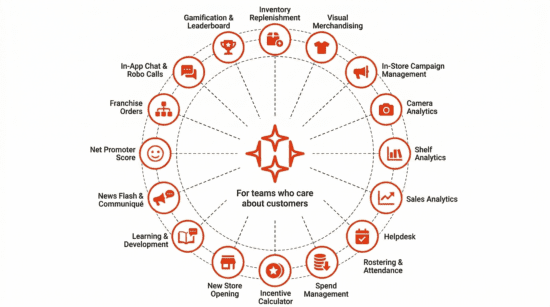
HipHip.AI is an AI-powered, end-to-end retail execution platform used across 10,000+ retail brick and mortar stores. It unifies inventory, merchandising, campaign management, store teams, and store spend into a single operating system—enabling real-time visibility and execution across stores.
Core capabilities include:
- Inventory Replenishment
- Visual Merchandising
- In-Store Campaign Management
- Camera Analytics
- Shelf Analytics
- Sales Analytics
- Helpdesk
- Task Manager
- Rostering & Attendance
- Spend Management
- Incentive Calculator
- New Store Opening
- Learning & Development
- News Flash & Communiqué
- Net Promoter Score
- Franchise Orders
- In-App Chat & Robo Calls
- Gamification & Leaderboard
HipHip.AI integrates seamlessly with existing POS, ERP, WMS, and HRMS systems, ensuring zero disruption to current infrastructure while unlocking smarter, faster retail execution.
Talk to an expert → hiphip.ai
Frequently asked questions
Why do VM checklists fail in retail stores, even when guidelines are detailed?
VM checklists fail because Visual Merchandising is visual and interpretive, not binary. Text-based checklists assume store teams already know what “good” looks like. In real store conditions, such as staff rotation, time pressure, missing props, or smaller formats, the same checklist is interpreted differently across stores, leading to inconsistency.
How do large retail brands ensure consistent VM execution across hundreds of stores?
Brands that achieve consistent VM execution move beyond static checklists and audits. They provide visual guidance at the point of execution, validate execution using photo proof, and focus managers on exceptions rather than chasing every store. This shifts VM from an instruction-driven process to a verified execution system.
What is the difference between VM compliance and VM execution?
VM compliance answers the question “Was the task completed?”
VM execution answers the question “Was the task executed correctly, as the brand intended?”
Most traditional systems measure compliance. High-performing retail brands focus on execution quality.
As a Head of Retail, how do I reduce VM escalations without increasing audits?
Reducing escalations requires catching execution issues earlier at the store level. Brands do this by validating VM execution in real time through visual proof and automated checks, instead of relying on delayed audits and manual follow-ups. When issues are resolved early, escalation volume naturally drops.
What role does HipHip.AI play in improving VM execution?
HipHip.AI acts as a VM execution system rather than a checklist or audit tool. It helps brands translate VM guidelines into image-led tasks, validate execution through photo proof, and automatically flag deviations. This allows store teams to execute with clarity and managers to focus only on exceptions.
How does HipHip.AI reduce the need for manual VM audits?
By validating VM execution at the point of action using AI-led photo checks, HipHip.AI catches issues before they require audits. Brands using HipHip.AI typically see a significant reduction in routine manual audits, as audits become exception-based rather than the default control mechanism.
Can HipHip.AI help during campaign and seasonal VM rollouts?
Yes. Campaign VM often fails due to time pressure and interpretation gaps. HipHip.AI provides visual campaign-specific guidance and real-time validation, helping stores execute faster and more accurately. Brands using this approach report fewer escalations and smoother campaign rollouts.
Is HipHip.AI meant for store teams, managers, or head office?
HipHip.AI is designed for all three, but in different ways:
- Store teams get clear visual guidance and instant feedback
- Managers get exception-based visibility instead of manual follow-ups
- Head office gets consistent execution data and visual proof across regions