


How HipHip.AI’ ops checklist connects retail execution into one system

Consistency is hardest to maintain at the store level.
Even when processes are clearly defined, execution tends to vary from one location to another.
- A campaign is launched, but implementation varies across locations.
- An issue is raised, but resolution depends on follow-ups.
- A checklist exists, but adherence is inconsistent.
- An incentive is calculated, but it does not reflect how work was actually done.
This disconnect between execution and outcomes is also explored in relationship between staff stress and NPS decline, where operational gaps directly impact performance metrics.
What is missing here is a structured way to ensure that work gets executed consistently across stores.
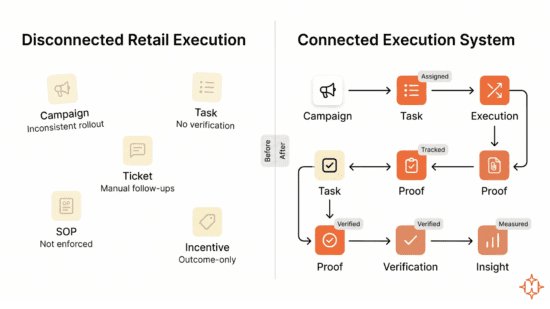
This lack of structure often shows up in operational blind spots, similar to how why help requests go unnoticed on the shopfloor highlights gaps between issue reporting and resolution.
HipHip.AI’s Ops Checklist works as this execution layer across stores.
Across 2500+ retail stores we have worked with, we have observed these patterns repeat consistently. These are not gaps in capability, but gaps in how execution flows across systems.
What HipHip.AI’s ops checklist actually does
HipHip.AI’s Ops Checklist is not a static checklist or a digitized SOP. It functions as the execution layer that standardizes how work gets done across retail operations.
Across retail teams we have worked with, the challenge is rarely defining tasks. It is ensuring they are executed consistently, tracked in real time, and verified on the ground.
HipHip.AI converts operational intent into structured, trackable, and verifiable actions that can be executed consistently across stores.
Every operational activity moves through a defined lifecycle:
Assigned → In Progress → Verified
This lifecycle ensures that ownership is clear, progress is visible in real time, and completion is validated with proof.
More importantly, this structure becomes the common execution framework across task management, helpdesk and ticketing, workforce management, smart L&D, incentives and rewards, spend management, and business insights.
What you can actually do with HipHip.AI’s ops checklist
HipHip.AI’s Ops Checklist is built to reflect how retail actually operates, not just how tasks are listed.
Teams can design execution workflows that match real store behavior:
- Create daily, weekly, and campaign-based checklists
- Assign tasks role-wise across store staff, managers, and cluster heads
- Capture proof of execution using images, videos, and comments
- Set up recurring checklists for routine operations
- Define dependencies between tasks
- Enable automatic escalations for delays or missed tasks
- Track execution across store, cluster, and head office levels
- Convert tickets, audits, and operational requests into actionable tasks
- Link execution outcomes to training, incentives, and performance
This ensures that operations are not just defined but actually executed in a consistent and measurable way.
| Operational Function | Without a Connected Execution Layer | With HipHip.AI Ops Checklist |
| Task Management | Tasks are assigned but not verified | Tasks are executed with proof and tracked across stages |
| Helpdesk & Ticketing | Issues are logged but follow-ups are manual | Tickets become actionable tasks with SLA tracking |
| SOPs | Documents exist but are not enforced | SOPs are executed through structured checklists |
| Workforce Management | Attendance is tracked but work is unclear | Execution is mapped to roles and performance |
| Incentives & Rewards | Rewards are based only on outcomes | Incentives are linked to execution quality |
| Spend Management | Approvals are delayed and fragmented | Requests follow structured workflows |
The shift is clear. Operations move from managing activities to ensuring execution.
How HipHip.AI’s ops checklist powers 7 core retail functions
1. Task management becomes structured execution
HipHip.AI’s Task Management module ensures that work is not just assigned but completed with accountability.
Tasks are embedded within checklists, assigned to specific roles, and tracked through completion with proof. Recurring checklists ensure that routine activities are never missed, while escalations ensure that delays are surfaced automatically.
Example: A fashion retailer launches a campaign requiring display and signage updates across 120 stores. In a typical setup, execution varies, and managers rely heavily on calls and follow-ups to track progress.
With HipHip.AI’s Ops Checklist, the rollout is deployed as a checklist with role-based tasks, deadlines, and proof capture. Store teams upload execution images, while managers track progress in real time and receive automatic alerts for delays or inconsistencies.
2. Helpdesk & ticketing becomes actionable
HipHip.AI’s Helpdesk & Ticketing module ensures that issues move beyond logging and into structured resolution.
Every ticket is converted into a checklist-driven task and tracked through completion with SLA visibility.
Example: A grocery store reports a refrigeration issue that risks spoilage of perishable inventory. Typically, the ticket moves across teams, and resolution depends on repeated follow-ups.
With HipHip.AI’s Ops Checklist, the issue is converted into a checklist task with defined SLAs. It is assigned to the right team, tracked in real time, and only closed after proof of resolution, ensuring faster and accountable action.
3. Workforce management becomes performance-driven
HipHip.AI’s Workforce Management module connects attendance and scheduling with actual execution.
Roles are mapped to checklist tasks, and performance is evaluated based on completed work rather than just presence.
Example: A store shows full attendance across all shifts but consistently scores low in audits related to hygiene and merchandising. Without execution visibility, the issue remains unclear.
With HipHip.AI’s Ops Checklist, managers can see which checklist tasks are being missed and which roles are underperforming. This allows them to take targeted action based on actual execution gaps instead of making assumptions.
4. Smart L&D becomes contextual training
HipHip.AI’s Smart L&D module ensures that training is driven by real execution gaps rather than assumptions.
Training is triggered based on patterns observed in checklist performance.
Example: A brand notices that multiple stores are incorrectly executing a new visual merchandising guideline despite detailed SOPs. Re-sharing instructions does not fix the issue.
With HipHip.AI’s Ops Checklist, this pattern is identified through checklist data. Targeted micro-training modules are assigned to relevant teams, and improvement is tracked through subsequent executions.
5. Incentives & rewards align with execution
HipHip.AI’s Incentives & Rewards module connects performance directly to execution quality.
Task completion, audit scores, and checklist adherence are used to calculate incentives.
Example: Two stores achieve similar sales during a promotional period, but one consistently follows SOPs and completes operational tasks on time, while the other shows gaps.
With HipHip.AI’s Ops Checklist, execution metrics are captured and factored into incentives, ensuring rewards reflect both outcomes and operational discipline.
6. Spend management becomes structured and controlled
HipHip.AI’s Spend Management module ensures that store-level expenses are tracked and approved through structured workflows.
Example: A store needs immediate approval for a repair during peak hours, but traditional approval processes cause delays and disrupt operations.
With HipHip.AI’s Ops Checklist, the request is raised and routed through a structured workflow. It is processed in real time with full visibility, ensuring both speed and control.
7. Business insights become real-time and actionable
HipHip.AI’s Business Insights module provides visibility based on actual execution data.
Dashboards and AI alerts highlight patterns, delays, and recurring issues.
Example: A cluster of stores consistently delays checklist completion, but the issue is only noticed during periodic reviews. By then, the impact is already visible.
With HipHip.AI’s Ops Checklist, execution data feeds dashboards and alerts in real time, allowing managers to intervene early and prevent escalation.
The execution flow that connects everything
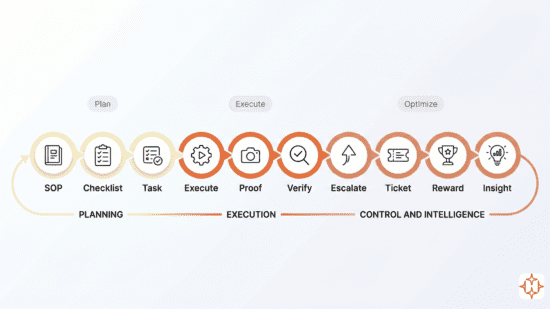
At the center of HipHip.AI is a continuous execution flow:
This ensures that there are no gaps between systems, no loss of ownership, and no delays in action.
How this works across retail hierarchy
- At the store level, teams execute tasks and submit proof.
- At the cluster level, managers monitor execution and intervene when required.
- At the head office, leaders define workflows and track performance across locations.
All functions operate on the same execution data, ensuring alignment across the organization.
This is not about managing operations better. It is about making them execute reliably
Most retail organizations do not struggle with defining what needs to be done. They struggle with ensuring that it gets done consistently across every store.
HipHip.AI’s Ops Checklist solves this by turning every operational activity into a structured, trackable, and verifiable workflow.
- Tasks are completed with proof.
- Issues are resolved through execution.
- SOPs are enforced on the ground.
More importantly, all systems operate as one.
When execution becomes consistent, performance becomes predictable. Escalations reduce. Accountability improves.
Operations stop being managed in parts and start running as a system.
About HipHip.AI
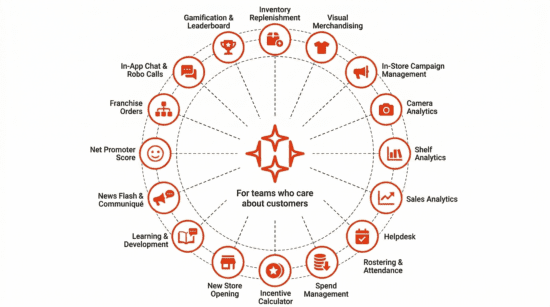
HipHip.AI is an AI-powered, end-to-end retail execution platform used across 10,000+ retail brick and mortar stores. It unifies inventory, merchandising, campaign management, store teams, and store spend into a single operating system—enabling real-time visibility and execution across stores.
Core capabilities include:
- Inventory Replenishment
- Visual Merchandising
- In-Store Campaign Management
- Camera Analytics
- Shelf Analytics
- Sales Analytics
- Helpdesk
- Task Manager
- Rostering & Attendance
- Spend Management
- Incentive Calculator
- New Store Opening
- Learning & Development
- News Flash & Communiqué
- Net Promoter Score
- Franchise Orders
- In-App Chat & Robo Calls
- Gamification & Leaderboard
HipHip.AI integrates seamlessly with existing POS, ERP, WMS, and HRMS systems, ensuring zero disruption to current infrastructure while unlocking smarter, faster retail execution.
Talk to an expert → hiphip.ai
Related reads
- Why empty premium zones quietly lose sales
- Why queue mismanagement is the fastest way to lose sales
- How brands reduce VM errors using visual examples
- VM reporting dashboards what it should look like for retail leaders
- How real-time inventory tracking improves store availability
Frequently asked questions
- If we already have task management and ticketing tools, why do we need an ops checklist layer?
Most retail systems are built to manage specific functions, not execution across functions. Task management assigns work, and ticketing tracks issues, but neither ensures consistent execution at the store level.
HipHip.AI’s Ops Checklist connects these systems through a shared execution lifecycle. It ensures that tasks, tickets, and SOPs are executed with clear ownership, real-time visibility, and proof of completion, reducing dependency on manual follow-ups.
- How is HipHip.AI’s ops checklist different from a standard checklist or SOP tool?
Standard checklists document what needs to be done, but they do not enforce how it gets done.
HipHip.AI’s Ops Checklist functions as an execution engine with role-based assignment, proof capture, escalation logic, and automation across modules. It also connects execution to training, incentives, and performance tracking, making it an active system rather than a passive document.
- What ensures that store teams actually complete tasks correctly and not just mark them as done?
HipHip.AI’s Ops Checklist requires proof-based completion. Store teams must submit images, videos, or comments as evidence of execution.
Managers can verify this before marking tasks as complete. If tasks are delayed or missed, automatic escalations ensure visibility at higher levels, enforcing accountability without manual intervention.
- Will HipHip.AI replace our existing systems like ERP, POS, or workforce tools?
HipHip.AI does not replace core systems such as ERP or POS.
It operates as an execution layer that ensures activities driven by those systems are carried out correctly at the store level. It connects workflows across systems and ensures that plans are translated into consistent action.
- How does HipHip.AI ensure accountability across multiple stores and hierarchy levels?
HipHip.AI’s Ops Checklist assigns every task to a specific role and tracks it through the execution lifecycle.
Store teams execute tasks, cluster managers monitor progress, and head office teams track overall performance. Escalations are triggered automatically for delays or missed tasks, ensuring that accountability is maintained across all levels.
- How does HipHip.AI connect execution to incentives and performance measurement?
HipHip.AI integrates execution data directly into the Incentives & Rewards module.
Metrics such as task completion, checklist adherence, and audit performance are used to evaluate performance. This ensures that incentives reflect actual work done on the ground and reinforce consistent execution across stores.