


How AI-led checklists prevent small execution gaps from becoming big revenue problem

A global retail brand with over 1,000 stores rolls out a new campaign with clear display guidelines to be executed before store opening.
Each store is expected to install signage, arrange featured products, align fixtures, and set up key display zones as per the brief.
In several stores, the setup is completed before opening as expected. In others, key elements such as signage or product placement are still being put in place after the store has already opened. In some cases, gaps are noticed and corrected later in the day.
By the end of the day, the display is complete.
The checklist reflects completion.
Across stores, however, the same display has not been executed in the same way or at the same time.
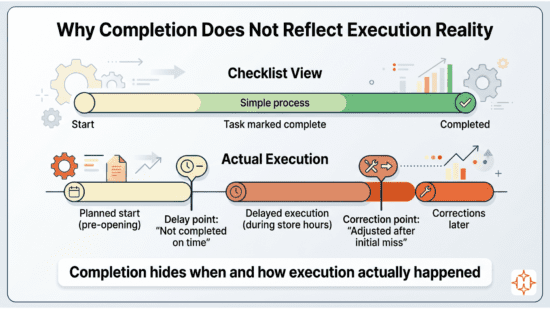
This is where small execution gaps begin to pass through unnoticed.
What we’ve observed across retail operations
With our experience of working with large retail teams across global markets, this pattern shows up consistently across different store tasks.
Tasks are rarely left incomplete. They are completed later than expected, adjusted during execution, or corrected after the fact.
For example, during display setup:
- A section is not arranged before opening and is completed later
- A product placement is missed during initial setup and corrected afterward
- A guideline is interpreted differently and adjusted during the day
Each of these is resolved. The task still reaches completion.
What is not captured is when the gap occurred.
In many cases, teams rely on surface-level validation, which is why before-after photos hide the real retail problem often leads to a false sense of execution accuracy.
As this repeats across stores:
- Delays become part of normal execution
- Corrections become routine
- The same gaps begin to appear across locations
Execution starts to vary, even though completion continues to look consistent. This is exactly why VM guidelines break across multi-store retail becomes a recurring challenge across distributed store networks.
How to prevent small tasks from being missed
To prevent small tasks from being missed, execution needs to be structured around how work actually happens throughout the day.
This is where modern AI-led checklists play a critical role.
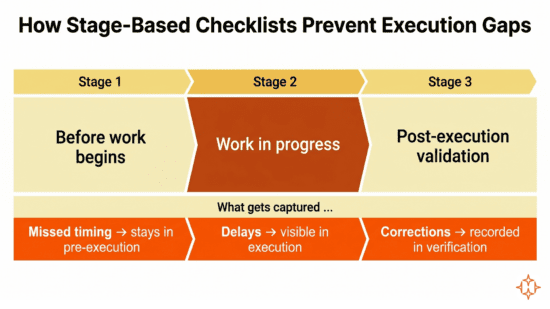
Instead of using a single checklist that captures only final completion, execution needs to be broken into AI-led checklists that reflect how tasks move from start to finish.
This means using:
- A pre-execution checklist to confirm what must be completed before work begins
- An execution checklist to track how the task is actually carried out
- A verification checklist to confirm whether the task was completed correctly
When checklists are structured this way:
- Tasks that are not completed at the expected time remain visible
- Work that continues into later stages is not merged into completion
- Corrections are separated from first-time execution
Applied to the same display setup:
- If setup is not completed before opening, it remains incomplete in the pre-execution checklist
- If execution continues into store hours, it stays within execution instead of being marked done
- If elements are added later, they are recorded during verification as corrections
This ensures that small gaps are identified at the stage where they occur, instead of being absorbed into final completion.
How HipHip.AI’s Ops Checklist bridges this gap
To prevent small execution gaps from compounding, tasks need to be structured around how they actually move through the day.
HipHip.AI’s Ops Checklist enables teams to:
- Break tasks into stage-specific checklists instead of relying on a single daily list
- Track when execution starts, not just when it is completed
- Capture misses, delays, and interruptions at the stage where they occur
- Separate first-time execution from post-execution corrections
This allows teams to identify small gaps at the point where they happen, before they begin to repeat across stores.
HipHip.AI’s Ops Checklist enables visibility across all stages of execution, ensuring that work moves forward without steps getting missed or pushed to later stages.
For example:
While rolling out campaigns:
- Stage-wise task assignment ensures display setup is completed before store opening
- In-progress tracking keeps setup active if it continues into store hours
- Image proof ensures the display is fully ready before closure
During new store opening readiness:
- Stage-based progression ensures readiness tasks are completed in sequence
- Mandatory inputs ensure each task is completed before moving ahead
- Verification checkpoints confirm readiness at opening
For stock checks on high-demand products:
- Time-bound tasks ensure checks are completed within defined windows before peak hours
- Time-stamped execution shows when checks actually happen
- Independent task closure separates planned checks from follow-up replenishment
For visual merchandising consistency:
- Image-based validation ensures setup aligns with guidelines during execution
- Stage movement tracking keeps progress visible during setup
- Revision logging separates updates from the original setup
For daily store readiness:
- Scheduled task windows ensure pre-opening tasks are completed before store opening
- Live execution tracking keeps tasks active if they continue into store hours
- Completion verification confirms readiness before it is marked complete
Across these scenarios, execution is driven through time-bound tasks, required inputs, and stage-wise validation, ensuring that work is completed as expected rather than adjusted later.
Closing thoughts
Execution consistency does not break all at once. It shifts gradually when delays, corrections, and missed steps are absorbed into normal operations.
When every task ends in completion, these shifts are difficult to detect. Over time, they begin to show up as differences across stores in how work is actually carried out.
What matters is whether these gaps are visible at the point where they occur.
A checklist that only confirms completion cannot do this. Execution needs to be tracked as it happens, so teams can act early and maintain consistency across stores.
About HipHip.AI
HipHip.AI is an AI-powered retail execution platform built to bring visibility and control to multi-store operations.
It enables teams to move beyond task completion and understand how execution is actually happening across stores. By connecting store-level activity with real-time data, it helps identify gaps early, before they scale into larger operational issues.
Used across 10,000 plus brick and mortar stores, HipHip.AI unifies key retail functions into a single operating system, including inventory, merchandising, campaigns, store teams, and store spend. This allows leadership teams to track execution consistently across locations without relying on fragmented systems.
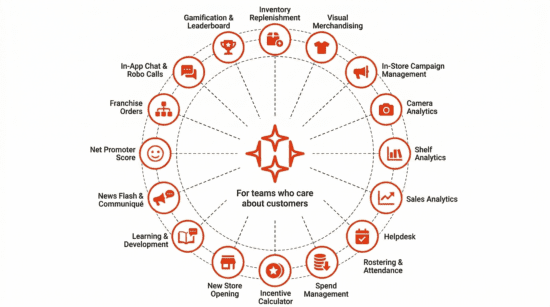
Core capabilities include:
- Inventory Replenishment
- Visual Merchandising
- In-Store Campaign Management
- Camera Analytics
- Shelf Analytics
- Sales Analytics
- Helpdesk
- Task Manager
- Rostering and Attendance
- Spend Management
- Incentive Calculator
- New Store Opening
- Learning and Development
- News Flash and Communiqué
- Net Promoter Score
- Franchise Orders
- In-App Chat and Robo Calls
- Gamification and Leaderboard
HipHip.AI integrates with existing POS, ERP, WMS, and HRMS systems, ensuring that teams can improve execution visibility without disrupting current workflows.
Talk to an expert: hiphip.ai
Related reads
- Why campaign execution breaks differently across regions
- Why 30% of stores drive nearly 70% of VM breakdowns
- Real-time VM alerts vs manual audits
- How to ensure VM compliance across stores using AI
- Replenishment breakdowns start with visual blind spots
Frequently asked questions
- If checklist completion rates are consistently high, how do we detect where execution is actually breaking?
High completion rates only confirm that tasks are being marked as done. They do not reflect how those tasks were executed.
To understand where execution is breaking, teams need to look at how checklists capture execution across stages:
- Whether tasks are completed within the expected stage, such as before store opening
- Whether execution continues into later stages instead of being completed on time
- Whether corrections are recorded separately or absorbed into completion
When checklists are structured this way, delays and corrections become visible at the point where they occur rather than at the end of the day.
- How can operations teams differentiate between normal store-level adjustments and early signs of execution drift?
Store-level adjustments are part of daily operations, but they usually remain isolated.
Execution drift begins when the same type of adjustment starts repeating:
- Across multiple stores
- Over consecutive days
- Within the same stage of execution
The key is to identify repetition within the same stage. Once deviations begin to appear consistently at a specific stage, they indicate a broader execution gap rather than isolated adjustments.
- Why do recurring execution issues fail to surface clearly in centralized reports?
Most reporting systems rely on final checklist completion as the primary signal.
Once a task is marked complete, it is treated the same regardless of:
- When it was completed
- Whether it required correction
- Which stage the deviation occurred in
This merges delayed and corrected execution into a single outcome, making recurring issues difficult to identify across stores.
- At what point does a small, correctable task-level issue become a systemic operational problem?
A task-level issue becomes systemic when it starts repeating across stages and locations.
This typically happens when:
- The same step is consistently missed or delayed at a specific stage
- Corrections become part of the normal workflow
- Execution varies across stores for the same checklist
At that point, the issue reflects a gap in how execution is being managed, not just an isolated miss.
- What specific signals should trigger early intervention before these gaps scale further?
Early intervention should be based on patterns observed within structured checklists.
Key signals include:
- Tasks not being completed within the expected stage
- Execution spilling into later stages such as store hours
- Frequent corrections during verification
- Variation in execution across stores for the same checklist
When these patterns repeat, they indicate that execution gaps are forming and need to be addressed before they scale.
- How can teams implement stage-based checklists effectively across stores?
Stage-based checklists need to reflect how work actually happens through the day.
This means:
- Separating pre-execution, execution, and verification stages
- Ensuring tasks cannot be closed without completing required inputs
- Tracking completion within the expected stage instead of allowing late closure
Platforms like HipHip.AI help operationalize this by structuring checklists across stages and ensuring that execution is validated at each step rather than only at final completion.