


How retailers allocate new SKUs without historical sales data (retail allocation guide)

Allocation becomes straightforward once demand patterns are established.
Retailers can analyze past demand, identify which stores sell faster, and distribute inventory accordingly.
But the real challenge appears when a new SKU launches.
A retailer must decide:
- which stores should receive the product
- how much inventory each store should get
- how quickly the product should be replenished
And all of this must happen before a single unit has been sold. This is known as initial allocation, and it is one of the most difficult decisions in retail planning.
At this stage, allocation is not based on observed demand. It is a decision made in advance of demand, using incomplete signals
As per our experience working with multi-store retail networks at HipHip.ai, many inventory imbalances originate during this stage.
This article explains how leading retailers allocate new SKUs more intelligently even when no historical sales data exists.
Why initial allocation is one of the hardest decisions in retail
When a new SKU launches, retailers lack the most important input for allocation: sales history.
Yet inventory still needs to be distributed across dozens or hundreds of stores.
In large retail networks, demand is influenced by multiple variables:
- store location
- customer demographics
- local demand patterns
- store traffic levels
- category performance
- promotional activity
- seasonal events
These variables cause demand to diverge significantly across stores, even for identical products.
As per our experience at HipHip.ai, once a retailer operates more than 50–100 stores, these demand differences become very visible.
Why equal allocation fails in multi-store retail?
Many retailers distribute new products evenly across stores during launches because it simplifies planning. However, equal allocation rarely matches real demand.
Consider a sportswear retailer launching a new sneaker model across 120 stores.
A uniform allocation strategy might distribute inventory like this:
| Store Type | Number of Stores | Initial Allocation Per Store |
| University district stores | 30 | 40 units |
| Mall flagship stores | 50 | 40 units |
| Corporate district stores | 40 | 40 units |

At first glance, this appears balanced. But once the product launches, sales patterns quickly diverge. Within the first week, point-of-sale data reveals the following:
| Store Type | Avg Weekly Sales | Footfall | Conversion Rate |
| University district | 24 units | 3,500 | 6.80% |
| Mall flagship | 17 units | 6,200 | 4.90% |
| Corporate district | 8 units | 2,900 | 2.10% |
Within days:
- university stores approach stockouts
- mall stores sell steadily
- corporate stores accumulate excess inventory
As per our experience working with retail operations teams at HipHip.ai, this divergence often appears within 3–5 days of launch. The issue is not inventory supply.
It is initial allocation accuracy.
How retailers estimate demand when a new SKU has no sales history
When new SKUs have no sales history, retailers rely on proxy demand signals. Instead of predicting demand from scratch, planners analyze several indicators that correlate with store-level demand.
| Sales Performance of Similar Products |
|
| Category Demand by Store |
|
| Store Demographics |
|
| Store Traffic and Conversion Rates |
|
| Local Demand Drivers |
|
In most cases, allocation happens before demand is observed.
What follows is a process of correcting that initial decision as real demand signals appear.
Different retailers approach this problem in different ways, but the underlying objective remains the same: reduce the risk of committing too much inventory before demand is understood.
How Zara reduces allocation risk during new product launches
Zara is known for its small initial allocations.
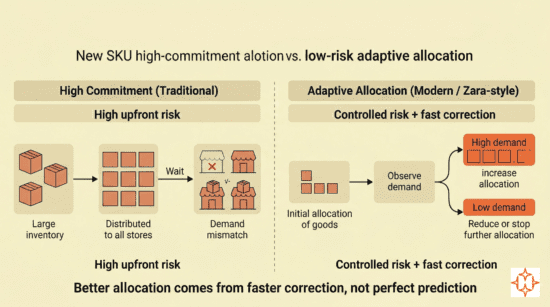
Instead of sending large quantities to every store, Zara typically distributes limited inventory across selected stores first.
This allows them to observe demand signals quickly.
If a product sells well, additional inventory is produced and distributed rapidly. If demand is weak, production is reduced.
This strategy minimizes risk and improves sell-through.
How Nike allocates new product drops across store networks
Nike often uses store segmentation and demand analytics for initial allocation.
Stores are classified based on factors such as:
- market size
• athlete participation rates
• store traffic
• category performance
High-performance stores receive larger allocations for new launches, especially during major product drops.
How Decathlon uses data to guide initial product allocation
Decathlon uses data-driven planning models to determine allocation.
These models incorporate signals such as:
- local sports participation
- historical category demand
- regional climate
- store catchment demographics
This allows them to tailor inventory allocation to the demand potential of each location.
Common mistakes retailers make when allocating new SKUs
Despite advances in retail analytics, several allocation mistakes remain common.
-
Equal allocation across stores
-
Ignoring store segmentation
-
Relying only on historical averages
-
Slow response to early demand signals
Retailers that avoid these mistakes typically achieve much stronger product launch performance.
Conclusion
Initial allocation is one of the most critical decisions in retail operations.
When new products launch without historical sales data, retailers must rely on demand signals, store characteristics, and category performance to estimate where inventory should go.
Retailers that combine:
- store segmentation
• proxy demand signals
• real-time sales monitoring
can dramatically improve launch performance.
Allocation without historical data is not a forecasting problem. It is a decision problem under uncertainty.
Retailers that manage this well do not try to eliminate uncertainty. They design systems that respond to it quickly once demand signals begin to emerge.
About HipHip.AI
HipHip.AI helps retail brands improve store execution and inventory performance across large store networks. The platform analyzes store-level demand signals, inventory levels, and product performance to support smarter allocation and replenishment decisions. In addition to inventory intelligence, HipHip.AI also enables visual merchandising compliance, store operations tracking, and retail analytics.
Frequently asked questions
How do retailers decide how much inventory to send to each store for a new product?
When a new product launches without a sales history, retailers typically rely on proxy signals such as category demand, store traffic, customer demographics, and the performance of similar products. These signals help estimate how much demand each store is likely to generate so that inventory can be allocated more accurately.
What is initial allocation in retail inventory planning?
Initial allocation refers to the first distribution of inventory across stores when a new product launches. Since there is no sales history for the product yet, retailers must estimate demand using data such as category performance, store segmentation, and customer profiles.
How do retailers estimate demand for a new SKU without historical sales data?
Retailers typically analyze the performance of similar products, category sales by store, store traffic levels, and demographic signals. These inputs help planners estimate which stores are most likely to generate strong demand for the new product.
How does AI improve initial allocation decisions in retail?
AI models can analyze multiple demand signals simultaneously, including store demographics, category performance, traffic patterns, and product attributes. This allows retailers to generate more accurate initial allocation recommendations than traditional rule-based planning methods.
How does HipHip.AI help retailers improve initial allocation decisions?
HipHip.AI helps retail teams analyze store-level demand signals, inventory performance, and product trends across their store network. By identifying where demand is likely to emerge and monitoring early sales signals, the platform helps retailers allocate inventory more intelligently and respond quickly when demand patterns change.
Related reads
- The hidden visibility gaps that quietly break your replenishment system
- What retailers are doing differently to fix replenishment at scale
- Why most forecasts fail at the store level—and how to fix it
- How retailers avoid overstocking and stockouts during peak seasons
- What early risk signals look like at SKU and store level