


How leading retailers forecast demand at store-SKU Level

Retail demand rarely behaves the way forecasts expect.
A product that sells out in one store may move slowly in another. A sneaker that is popular near a university may sit unsold in a corporate district. A promotion that drives strong demand in one city may have little impact elsewhere.
Yet many retail planning systems still forecast demand at a national or category level, assuming demand behaves uniformly across stores.
Demand at the store level does not change in large, visible shifts. It moves gradually, often in ways that are difficult to detect early.
In large retail networks, this assumption quickly breaks down.
When demand forecasts fail to capture store-level differences, retailers face the same pattern repeatedly:
- shelves go empty in high-demand stores
- excess inventory accumulates in slower locations
- replenishment decisions react too late
Studies show that 20–30% of inventory is often misallocated across locations, meaning stock exists in the network but not where demand is actually occurring.
As per our experience working with large multi-store retailers at HipHip.ai, these inventory imbalances are rarely caused by supply shortages.
What store-SKU demand forecasting actually means
Traditional demand forecasting answers a broad question: “How many units of a product will sell this month or season?”
Modern retail forecasting asks a more specific question: “How many units of this SKU will sell in each store over time?”
In practice, forecasts are generated at the intersection of: Store × SKU × Time
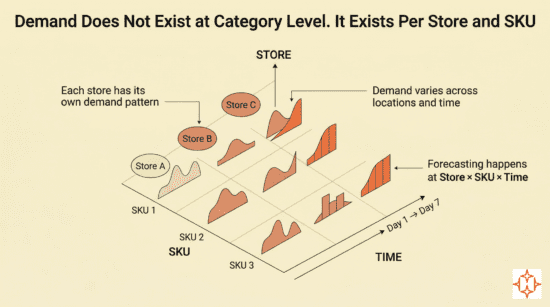
This means each store effectively has its own demand curve for every product. Demand does not diverge at the category level. It diverges store by store.
For example, consider a sportswear retailer selling the same running shoe across three store types.
| Store Type | Location Characteristics | Average Weekly Demand |
| University district store | Young customers, high athletic participation | 22 units |
| Mall flagship store | High footfall, broad customer base | 16 units |
| Corporate district store | Office workers, formal lifestyle | 7 units |
Although the same product is sold across all stores, demand patterns vary significantly due to differences in customer demographics, nearby activities, and store traffic.
Store-level forecasting captures these variations and predicts demand accordingly.
Why traditional demand forecasting breaks in retail
In modern retail environments, several structural limitations appear.
| Aggregated demand forecasts | Forecasts are often generated at national or regional levels and then distributed across stores. This masks significant differences in local demand. |
| Static planning cycles | Forecasts are typically updated monthly or seasonally, while demand patterns may shift within days. |
| Uniform inventory allocation | Many retailers distribute inventory evenly across stores during initial launches or seasonal resets. |
| Limited store-level demand signals | Legacy planning systems often lack the ability to continuously analyze store-level sales velocity. |
In large retail networks, aligning demand forecasting with inventory allocation can improve stock availability by 15–25%, directly impacting how much demand is captured at the store level.
As per our experience at HipHip.ai, once a retailer operates more than 50–100 stores, these limitations begin to create consistent operational problems.
These differences in how demand is interpreted and acted upon become clearer when viewed structurally:
| Aspect | Traditional Forecasting | Store-SKU Continuous Forecasting |
| Level of analysis | National / category | Store × SKU |
| Update frequency | Monthly / periodic | Continuous |
| Demand view | Historical averages | Real-time velocity + signals |
| Sensitivity to local demand | Low | High |
| Response timing | After imbalance | During demand shift |
| Outcome | Stock imbalance and delays | Timely allocation and replenishment |
What changes is not just how demand is estimated, but how early these changes become visible within the system.
How to forecast demand at store level?
Modern retail forecasting systems combine multiple signals to estimate demand more accurately. Instead of relying only on historical sales, they incorporate several variables that influence store-level demand.
| Historical sales velocity | Point-of-sale data reveals how quickly products are selling across different stores. |
| Store demographics | Customer profiles vary widely across locations.
Examples include:
|
| Store traffic patterns | Stores with higher footfall typically generate stronger demand for impulse purchases and seasonal products. |
| Promotions and marketing campaigns | Discounts, online campaigns, and influencer promotions often create short-term spikes in demand. |
| Seasonality and weather | Weather conditions strongly influence categories such as footwear, apparel, and sports equipment. |
| Local events | Concerts, festivals, and sporting events can significantly increase demand for specific products in nearby stores. |
These signals are typically combined to generate dynamic demand forecasts for each store-SKU combination.
In many retail systems, forecasts are updated at fixed intervals, while demand continues to evolve between those updates.
How do modern retail forecasting systems work?
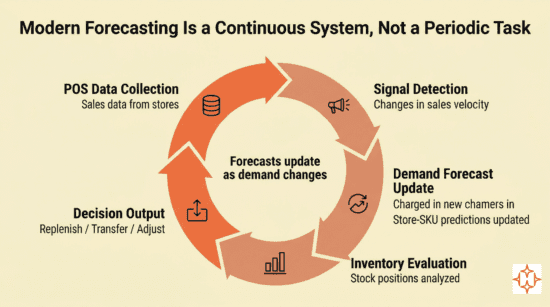
Behind the scenes, modern forecasting systems operate as continuous decision engines. Instead of generating forecasts periodically, they update predictions continuously as new data becomes available.
A typical forecasting workflow includes the following steps.
- POS sales data is collected from all stores
- Sales velocity changes are detected across SKUs
- Demand signals are analyzed at store level
- Store-SKU demand forecasts are updated
- Inventory positions are evaluated across the network
- Replenishment and transfer recommendations are generated
This continuous feedback loop allows retailers to respond to demand changes quickly rather than waiting for periodic planning cycles.
Example:
Consider a sportswear retailer operating 120 stores across three major cities. The retailer launches a new running shoe model and initially distributes inventory evenly across stores.
| Store Type | Initial Allocation | Store Count |
| University district stores | 40 units per store | 30 stores |
| Mall flagship stores | 40 units per store | 50 stores |
| Corporate district stores | 40 units per store | 40 stores |
This adjustment happens once demand signals at the store level become visible in time to influence allocation and replenishment decisions. Within the first 10 days, point-of-sale data reveals significant differences in demand.
| Store Type | Avg Weekly Sales | Conversion Rate | Footfall |
| University district | 24 units | 6.80% | 3,500/week |
| Mall flagship | 17 units | 4.90% | 6,200/week |
| Corporate district | 8 units | 2.10% | 2,900/week |
Additional signals reveal further insights:
- local marathon registrations increase demand near university stores
- influencer marketing campaigns increase demand in flagship malls
- corporate stores show lower engagement with athletic footwear
A modern forecasting engine incorporates these signals and updates demand predictions.
| Store Type | Updated Demand Forecast | Recommended Replenishment |
| University district stores | Very high demand | 60–70 units |
| Mall flagship stores | Moderate demand | 40–45 units |
| Corporate district stores | Low demand | 20–25 units |
In addition, the system may recommend transferring inventory from slower stores to faster-selling locations to prevent stockouts.
As per our experience working with retail teams at HipHip.ai, this type of adjustment can happen within days of a product launch when real-time store data is continuously monitored.
Forecasting becomes valuable when it is closely aligned with how demand is changing at the store level and how quickly that change can be acted upon.
How store-SKU forecasting improves replenishment?
Demand forecasting is not an isolated planning activity. Its real value lies in improving operational decisions across the retail network.
- Smarter inventory allocation
- Faster response to demand shifts
- Reduced excess inventory
- Higher product availability
These improvements significantly increase sell-through while reducing markdown risk.
Common mistakes retailers make in demand forecasting
Even retailers with sophisticated systems can encounter forecasting challenges.
Common mistakes include:
- Over-reliance on historical averages
- Ignoring local demand differences
- Forecast updates that are too slow
- Forecasting only at category level
Retailers that avoid these mistakes typically achieve much higher forecasting accuracy.
Conclusion
Demand forecasting has become one of the most critical capabilities in modern retail operations. Retailers that forecast demand at the store-SKU level gain a significant advantage.
They can:
- detect demand shifts earlier
- allocate inventory more accurately
- reduce stockouts
- improve sell-through across their store network
As store networks expand and demand becomes more fragmented, forecasting at the store-SKU level becomes a structural requirement rather than an operational choice.
About HipHip.AI
HipHip.ai helps retail brands improve store execution and inventory performance across large store networks. This shift requires systems that continuously track demand signals and translate them into decisions at the store-SKU level. The platform provides real-time visibility into store-level inventory, detects stockout risks early, and supports smarter replenishment decisions based on demand signals. In addition to inventory intelligence, HipHip also helps retailers manage visual merchandising compliance, store operations, and retail analytics.
Frequently asked questions
What does store-SKU demand forecasting mean in retail?
Store-SKU demand forecasting means predicting how many units of a specific product (SKU) will sell in each individual store over a given time period. Instead of forecasting demand only at a national or category level, retailers generate separate forecasts for every store and product combination.
How often do retailers update demand forecasts in modern systems?
Traditional forecasting systems were often updated monthly or seasonally. Modern retail forecasting platforms update demand predictions much more frequently, sometimes daily or even continuously, as new sales data and demand signals appear.
Can demand forecasting prevent stockouts in retail stores?
Demand forecasting plays a major role in reducing stockouts. By predicting demand at the store-SKU level, retailers can allocate inventory more accurately and replenish products before shelves run empty. While forecasting cannot eliminate stockouts completely, it significantly improves product availability.
How do retailers forecast demand for a completely new product with no sales history?
When launching new products, retailers often analyze historical sales data from similar SKUs, store demand patterns, and customer profiles to estimate expected demand. Machine learning models can also detect similarities between products and improve forecast accuracy even without direct sales history.
What is the difference between demand forecasting and inventory replenishment?
Demand forecasting predicts how much of a product is likely to sell in the future. Inventory replenishment uses those forecasts, along with current stock levels, to determine how much inventory should be sent to each store. In practice, forecasting and replenishment systems work closely together.
Why do demand forecasts sometimes fail in retail?
Forecasting errors often occur when systems rely too heavily on historical averages or ignore local demand differences between stores. Sudden promotions, social media trends, weather changes, or supply chain disruptions can also cause demand to shift unexpectedly.
How does HipHip help retailers forecast demand across stores?
HipHip helps retail teams monitor store-level sales signals and inventory performance across their store networks. By analyzing sales velocity, stock levels, and store demand patterns, the platform helps retailers detect demand shifts early and make smarter replenishment decisions.
Does HipHip replace existing ERP or inventory systems?
No. HipHip typically works alongside existing ERP, POS, and inventory management systems. It acts as an intelligence layer that analyzes store-level data and helps retail teams improve operational decisions such as forecasting, replenishment, and inventory balancing.
Related reads
- The hidden visibility gaps that quietly break your replenishment system
- What retailers are doing differently to fix replenishment at scale
- The real logic behind allocating new SKUs across stores
- How retailers avoid overstocking and stockouts during peak seasons
- What early risk signals look like at SKU and store level