


How messaging tools are breaking retail operations at scale (and what actually works)

Most retail store networks, even today, run their day to day communication on tools like WhatsApp, Telegram, Microsoft Teams, Slack, and email.
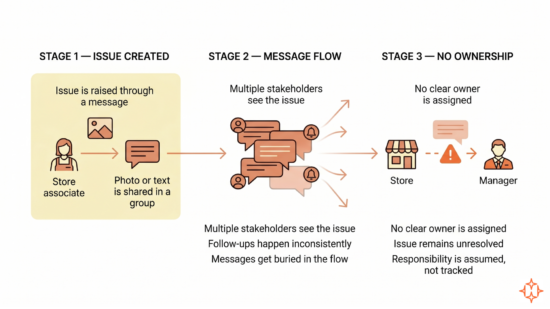
On the store floor, this is how issues move. A store associate drops a photo in a WhatsApp group. The manager follows up. Messages keep coming in. Some issues get picked up, some need repeated follow ups, and some quietly get lost in the flow.
As the network grows, this stops being manageable. Messages pile up faster than they can be tracked. The same issues keep coming back because nothing changed. There is no clear owner and no visibility beyond the message thread.
Once you realize these tools are built only for communication, not to handle retail operations, it becomes clear why issues keep piling up on the store floor.
A messaging tool cannot hold a network accountable
When an issue enters a group, it is seen by everyone and owned by no one. There is no clear assignment, no defined owner, and no way to know whether the issue was actually resolved or simply buried under the next set of messages.
The store assumes someone is handling it. The regional manager assumes the store is handling it. In reality, it sits in the middle, unowned and unresolved.
In our experience working with retail networks at HipHip.AI, this gap in ownership is one of the first breakdowns that shows up as operations scale. This is not a failure of discipline. It is what happens when a tool built for communication is used to manage execution.
Where the network pays for it
What starts as missed follow-ups on the store floor does not stay there. It shows up across the network in ways that are harder to trace, and more expensive to fix.
The same problem repeats across stores and nobody connects it
A display not set up properly in one store looks like a small issue.
In a messaging-led setup:
- The same issue shows up in other stores, but no one connects it
- Each store raises it separately, as if it is new
- There is no visibility into whether others are facing the same thing
- Store teams keep reporting, but nothing changes across locations
From the store floor, it feels like the same problem keeps coming back, without ever being fixed at the root.
| According to Salesforce, nearly 90% of companies fail to deliver on in-store promotional strategy despite massive investment. Not because the strategy is wrong, but because recurring execution issues across stores never get connected early enough to act on them. |
Frontline staff stop reporting
When issues are raised but nothing changes, behaviour on the store floor starts to shift.
At scale, this means:
- The same issue has to be reported multiple times before anyone acts
- Store teams start assuming they will have to follow up again and again
- After a point, only urgent issues get reported
- Smaller problems are ignored because it does not feel worth the effort
Across multiple retail networks we have worked with at HipHip.AI.AI, this drop in reporting is a consistent pattern once teams stop seeing outcomes from what they raise. From the store floor, reporting starts to feel like extra work with no outcome.
| 73% of frontline retail workers report being dissatisfied with the technology provided by their employers. The average retailer asks frontline staff to use two to three apps, in some cases as many as 20, creating fractured communication and confusion that makes structured reporting nearly impossible. |
There is nothing to show when the audit comes
When an audit or review comes in, store teams are asked what was raised and what got resolved.
In a messaging-led setup:
- Information is buried in long message threads
- It is not clear who took ownership of the issue
- There is no proper record of what was fixed
- Store teams have to search through old messages or rely on memory
From the store floor, it becomes difficult to show what was actually done, even when the work happened.
| The cost of not having that record is not small. It is measurable. Non-compliance costs organizations $14.82 million on average, while maintaining compliance systems costs $5.47 million. The difference is not the process. It is whether records can be produced when required. |
In a messaging-led system, this information usually cannot be produced when it is needed.
The cost builds over time, until it starts showing up in missed targets, delayed execution, and repeated failures across stores.
How HipHip.AI.AI’s helpdesk replaces the group chat
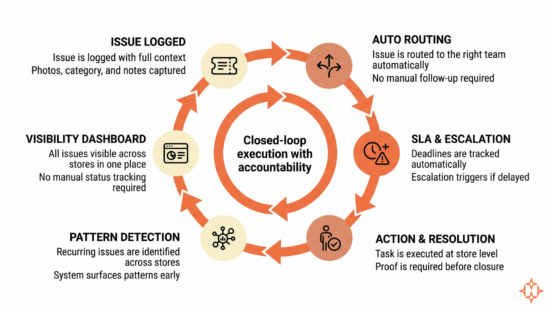
Every issue that enters HipHip.AI.AI’s Helpdesk moves through a defined lifecycle. Nothing depends on someone remembering to follow up.
- Logged with context from the floor. Photos, category, and notes attached at the point of creation, no follow-up message needed to explain what happened.
- Routed automatically. The VM issue goes to the VM team. The maintenance issue goes to facilities. The store manager does not have to figure out who to tell.
- SLA tracked, escalation automatic. Every ticket has a deadline. Breach it, and it escalates to the next level, with full history attached. No chase calls.
- Patterns surface across stores. The same issue appearing across seven stores in three weeks shows up as a pattern, not seven separate tickets. Visible before it becomes a revenue problem.
- Proof required before closure. No verbal confirmation. No assumed completion. A timestamped, retrievable record from open to close.
One dashboard showing every open issue across the network, by store, by age, and by SLA status, without a single status call.
What the network looks like when accountability is built in
- Cluster managers see what is open and what is recurring across their stores without a single follow-up call
- Head office evaluates performance on resolution data, not on the quality of the Friday update message
- When a compliance requirement goes out, there is a record of which stores executed, which flagged a blocker, and which marked it complete without completing it
- Frontline staff start reporting again because they can see that what they raise gets acted on
Closing thoughts
When issue resolution is structured, the operational model changes. Teams stop chasing updates. Escalations do not depend on follow-up calls.
Recurring problems surface before they turn into larger failures. And when leadership needs to know what is open, what is delayed, or where stores are struggling, the answer is already visible.
That is the difference between managing issues through conversation and managing them through a system designed for accountability at scale.
About HipHip.AI.AI
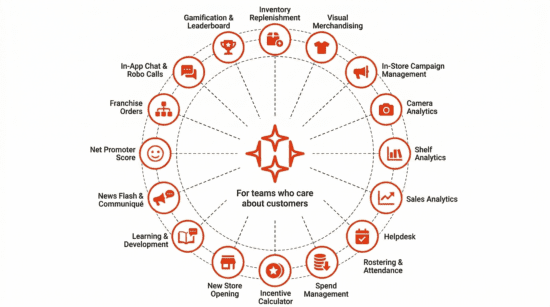
HipHip.AI.AI is an AI-powered, end-to-end retail execution platform used across 10,000+ retail brick and mortar stores. It unifies inventory, merchandising, campaign management, store teams, and store spend into a single operating system—enabling real-time visibility and execution across stores.
Core capabilities include:
- Inventory Replenishment
- Visual Merchandising
- In-Store Campaign Management
- Camera Analytics
- Shelf Analytics
- Sales Analytics
- Helpdesk
- Task Manager
- Rostering & Attendance
- Spend Management
- Incentive Calculator
- New Store Opening
- Learning & Development
- News Flash & Communiqué
- Net Promoter Score
- Franchise Orders
- In-App Chat & Robo Calls
- Gamification & Leaderboard
HipHip.AI.AI integrates seamlessly with existing POS, ERP, WMS, and HRMS systems, ensuring zero disruption to current infrastructure while unlocking smarter, faster retail execution.
Talk to an expert → HipHip.AI.ai
Frequently asked questions
- At what point does WhatsApp stop working for store issue management?
WhatsApp typically starts breaking down when issue volume grows beyond what managers can manually track across stores. The problem is usually not the number of stores alone, but the combination of issue frequency, multiple stakeholders, and the need for escalation and auditability.
Common signals include:
- Issues being raised repeatedly because earlier reports were missed
- Store teams following up manually for updates
- Escalations happening through calls instead of a defined process
- No clear view of unresolved issues across locations
- Difficulty producing records during audits or compliance reviews
- Why is a helpdesk better than using WhatsApp groups with stricter processes?
Stricter processes can improve discipline, but they do not change the limitations of a messaging tool. A helpdesk embeds structure into the process itself, so issue tracking does not depend on people remembering to follow up.
A helpdesk enables:
- Clear ticket ownership from the moment an issue is raised
- SLA-based tracking and automatic escalation
- Visibility into open, delayed, and recurring issues
- Searchable records and proof of resolution
- Pattern detection across stores, not just issue-level handling
- Can a structured helpdesk work for frontline store teams without adding complexity?
Yes, if designed for retail workflows, a helpdesk can reduce effort rather than add to it. Store teams log issues in a structured format once, instead of raising the same issue repeatedly through messages and calls.
In practice, it simplifies execution by:
- Standardizing how issues are reported
- Routing issues automatically to the right owner
- Reducing manual follow-ups for status checks
- Making escalation happen through the system, not through chasing people
- How does a helpdesk help identify recurring issues across multiple stores?
A helpdesk captures issues in a structured way, which makes it possible to analyze trends across stores, categories, vendors, or issue types. This helps distinguish isolated incidents from systemic problems.
For example, it can help surface:
- Repeated fixture failures linked to a vendor
- Recurring VM execution issues in specific regions
- Frequent maintenance delays tied to response bottlenecks
- Compliance issues appearing across multiple locations
- Does replacing WhatsApp mean store teams lose real-time communication?
No. Replacing WhatsApp for issue resolution does not mean removing communication. It means separating communication from issue control. Teams can still communicate in real time, while issue ownership, escalation, and resolution happen through a system built to manage them.
The difference is that:
- Conversations can happen without becoming the system of record
- Issues are tracked even when discussions move across stakeholders
- Resolution does not depend on message threads being monitored continuously