


How lost retail issues turn into daily breakdowns on the store floor

Across multi-store retail chains, problems get raised constantly. Store managers, VM leads, IT contacts, floor staff, issues come in from everywhere. The reporting part usually works.
Someone sends the message, flags the problem, loops in the right person. On paper, the system is working.
But between the moment a problem is flagged and the moment it is actually closed, there are several handoffs. Each one is a place where ownership gets blurry, urgency gets lost, and the issue quietly stops moving without anyone realizing it.
This is what that looks like in practice. Every issue follows the same path, and every stage of that path has a specific way it breaks down.
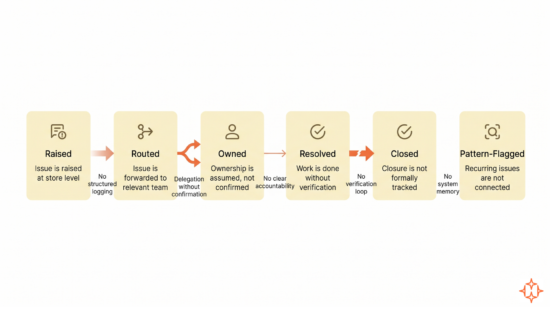
How issues actually move
Every issue moves through a series of stages once it leaves the store. Each stage looks straightforward on its own. The gaps show up in how the issue moves from one stage to the next.
Stage 1: Raised
Someone flags a broken fixture, a planogram mismatch, a POS error. That is the easy part. What is not easy:
- There is no record of when it was raised or who received it.
- There is no severity signal, so everything lands with the same weight.
- A WhatsApp message to the area manager is not a raised ticket. It is a message that may or may not be read, actioned, or remembered.
Stage 2: Routed
Most issues do not have an obvious single owner. Routing requires context: category, priority, which team, which store. Informally, it means forwarding the original message to someone who seems relevant. Three things consistently go wrong here:
- The forwarder thinks they have delegated. The receiver thinks they have been cc’d.
- Cross-functional issues, IT + procurement, VM + logistics, get routed to one team who waits for the other.
- No routing logic means urgency gets lost in translation.
Stage 3: Owned
This is the most dangerous stage. Ownership assumed is not ownership assigned. When a message is forwarded without explicit acknowledgment:
- Both parties often believe someone else is handling it.
- There is no timestamp on when ownership transferred.
- Nobody is lying. Nobody is negligent. The system simply has no mechanism to confirm that a specific person has accepted responsibility.
This is precisely where cross-functional issues die, in the gap between two teams with no one owning the handoff.
Stage 4: Resolved
Someone works on the issue and considers it done. But:
- Resolved according to whom?
- Was the fix verified at the store level?
- Did the person who raised it confirm the problem is actually gone?
Without a closure loop, resolved is just an optimistic assumption. The issue resurfaces next week with no institutional memory of what was tried before.
Stage 5: Closed
Completion is doing the task. Closure is formally confirming it is done, documented, and no longer requires action. Without that formal close:
- Most issues just stop getting mentioned, which gets mistaken for resolution.
- The original raiser eventually stops following up.
- The issue lingers in a grey zone where nobody knows its actual status.
Stage 6: Pattern-Flagged
If the same issue keeps recurring across stores, POS errors every Monday, planogram gaps every promo reset, that is not a one-time problem. It is a systemic failure in process, supplier, or training. Without a record of past issues:
- Every instance looks new and gets treated as one.
- It gets fixed the same way each time.
- Nobody ever asks the upstream question.
This is where operational intelligence dies.
How these issues actually play out in retail operations
Across stores, the scenarios look different on the surface. Different teams, different problems, different timelines. Underneath, the flow is consistent. The issue moves, stalls, and eventually sits without a clear owner.
Scenario 1: IT and Procurement
A store’s receipt printer fails. IT identifies that a replacement is needed. Procurement needs to initiate the purchase.
IT assumes procurement will proceed. Procurement waits for a formal indent and store approval. The store continues issuing handwritten receipts.
The issue stays active. Nobody owns the full outcome.
Day 1: Store manager flags it on WhatsApp. Read, no reply for 6 hours.
Day 2: Area manager forwards to IT. IT assumes someone else is already on it.
Day 4: IT emails procurement for a PO. Procurement asks for a formal indent. Thread dies.
Day 10: Store manager follows up. Nobody has a clear answer.
Two teams, one issue, zero shared ownership. The handoff lived in an assumption, and that is where it died.
Scenario 2: VM and Logistics
A seasonal planogram reset goes out. Fixtures for two stores have not arrived. VM thinks logistics handled the dispatch. Logistics says it was sent.
Neither team checks with the store. The store is still waiting.
Day 1: VM Lead emails all store managers to implement the reset. Stores 12 and 15 reply they have not received fixtures. The reply goes to all 18 stores. VM Lead does not catch it.
Day 3: Store 12 WhatsApps the area manager asking whether to implement what they have. Area manager says try your best, and follow up. No follow up happens.
Day 5: VM Lead checks with logistics. Logistics confirms all dispatches completed on Day 2. Both teams mark it resolved. The stores are still waiting.
Confirmation came from logistics’ own dispatch records, not from the store. The issue was closed at headquarters while the problem was still sitting on the floor.
Scenario 3: The recurring POS error nobody connects
Every Monday morning, three stores flag slow POS performance. IT fixes it each time, a background sync running overnight eats into system resources. Same root cause, six weeks in a row.
Weeks 1 to 6: Store managers WhatsApp IT support separately. Each instance is handled individually, by different IT staff, in different threads. Nobody sees the pattern.
Six identical issues. Six individual fixes. The permanent fix would have taken 10 minutes. It never happened because no one had a view across conversations.
Scenario 4: Ownership assumed, follow-up never comes
A store’s aircon unit breaks during peak summer. The area manager forwards it to the facilities team. Both assume the other is tracking it.
Day 1: Area Manager forwards to Facilities Lead. Facilities reply “on it.” No timeline, no ticket, no follow-up protocol.
Day 6: Store manager follows up with area manager. Area manager checks with facilities. Facilities: “I thought someone else followed up after I flagged the vendor.”
“On it” is not an SLA. No resolution deadline was set, no vendor contact was confirmed, and six days of peak summer trading passed with no owner on record.
Why informal systems break at scale
When a chain is small, the area manager knows every store personally. They remember the printer issue at Store 3 and the VM gap at Store 5. When something falls through the cracks, a phone call fixes it. Informal follow-up works because the surface area is small enough to hold in one person’s head.
As the chain grows, that changes.
- More stores means more area managers, each with partial visibility and no shared view.
- More teams means more handoffs across IT, VM, facilities, and procurement, with no bridge owner.
- More issues means patterns that would have been obvious to one person are now buried across dozens of threads and inboxes.
The problem is not the people. It is that the system was built for a size the chain no longer is.
What changes when issues move through HipHip.AI’s Helpdesk
When an issue enters HipHip.AI’s Helpdesk, it does not go into a chat thread. It becomes a ticket. That single shift changes everything that follows.
- Every issue is logged with a category, severity, timestamp, and store at the point of raising.
- Issues are routed to the right team automatically. No forwards, no assumptions.
- Cross-functional issues have a single assigned owner for the full outcome.
- Every handoff requires explicit acceptance before the ticket moves forward.
- Every issue has a resolution deadline. Missed deadlines escalate automatically.
- Closure requires proof of completion confirmed at the store level.
- Recurring issues across stores are flagged as patterns, not treated as fresh incidents.
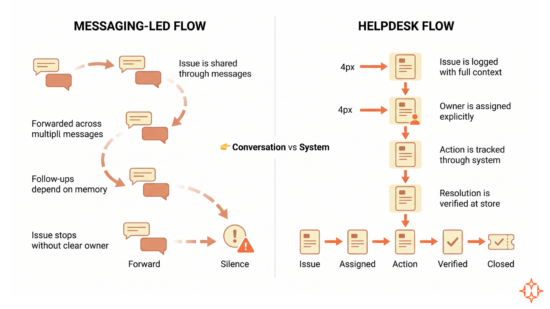
From that point, the issue is no longer moving through chats and emails. It moves through a system with a defined path.
Closing thoughts
Across stores, teams, and issue types, the pattern stays the same. The issue moves through multiple hands, slows down in between, and often sits without a confirmed close.
That flow does not change on its own. It needs a system that tracks how an issue moves from the moment it is raised to the moment it is actually closed.
A helpdesk does that. It gives every issue a single path, a clear owner at each step, and a record of what has happened so far.
Once that is in place, issues move through the system with a clear path and a confirmed close.
About HipHip.AI.AI
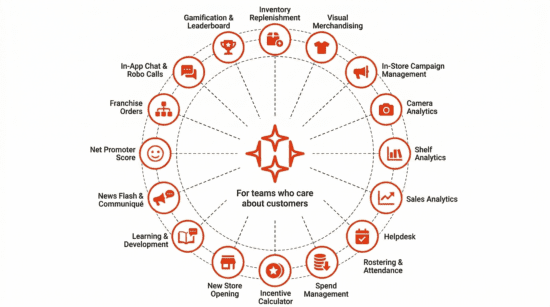
HipHip.AI.AI is an AI-powered, end-to-end retail execution platform used across 10,000+ retail brick and mortar stores. It unifies inventory, merchandising, campaign management, store teams, and store spend into a single operating system—enabling real-time visibility and execution across stores.
Core capabilities include:
- Inventory Replenishment
- Visual Merchandising
- In-Store Campaign Management
- Camera Analytics
- Shelf Analytics
- Sales Analytics
- Helpdesk
- Task Manager
- Rostering & Attendance
- Spend Management
- Incentive Calculator
- New Store Opening
- Learning & Development
- News Flash & Communiqué
- Net Promoter Score
- Franchise Orders
- In-App Chat & Robo Calls
- Gamification & Leaderboard
HipHip.AI.AI integrates seamlessly with existing POS, ERP, WMS, and HRMS systems, ensuring zero disruption to current infrastructure while unlocking smarter, faster retail execution.
Talk to an expert → HipHip.AI.ai
Frequently asked questions
- At what point in the lifecycle do most retail issues get lost?
Most issues get lost during transitions, not at the start or the end.
The critical points are:
- When the issue is routed to another person or team
- When ownership is assumed instead of explicitly assigned
At these stages, the issue remains visible but stops progressing. The delay is not tied to a person, it sits in the handoff.
- Why do issues appear “in progress” even when there is no real movement?
An issue can look active without actually moving forward.
This usually involves:
- Messages being exchanged
- Multiple people being looped in
- Acknowledgements without defined next steps
Without a clear owner and next action, the issue stays in conversation rather than moving toward resolution.
- Why do cross-functional issues break down more often than single-team issues?
Cross-functional issues introduce multiple handoffs.
Each handoff requires:
- Clear ownership of the next step
- Visibility into what has already been done
- Alignment between teams on responsibility
When these are missing, the issue sits between teams. Each team sees part of it, but no one tracks the full movement.
- Why do the same issues keep recurring across stores?
Recurring issues are usually treated as separate incidents instead of connected events.
In most setups:
- Each issue is handled independently
- There is no shared record across stores
- Root causes are not identified
As a result, the same problem is resolved multiple times without being fixed at the source.
- What changes when issues are managed through a structured helpdesk system?
A structured system changes how issues move across stages.
It introduces:
- Clear ownership at every step
- Tracked movement from raised to closed
- Visible handoffs between teams
- Defined timelines for resolution
- Pattern visibility across stores
This ensures that issues do not depend on follow-ups or memory to reach a clear close.