


Three critical inventory blind spots to audit before festival demand hits
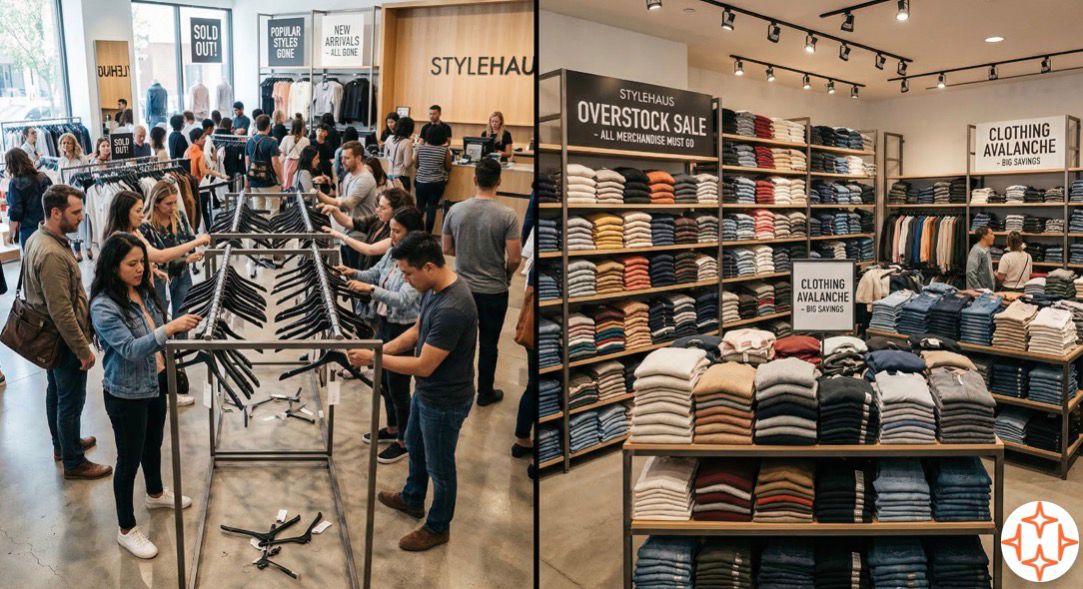
A fashion retailer entered the festive season fully prepared.
Seasonal demand forecasts were aligned with last year’s growth. Inventory was committed early to secure supply. Stock was evenly distributed across stores to ensure availability.
Within the first week, top-performing stores ran out of key styles, while slower locations continued to hold excess inventory.
This pattern repeats across categories and store networks.
The issue was not demand. It was execution.
Inventory decisions were made early, but they did not adapt as demand started shifting across stores and SKUs.
This gap between planning and in-season execution is where most retailers lose demand.
Closing this gap requires shifting from static planning to continuous, real-time execution.
Blind spot 1: Static planning assumptions
Most retailers plan festive inventory 3–6 months in advance using historical sales, store performance, and product-level demand patterns. Under stable conditions, a standard inventory management system works.
These plans assume demand will behave predictably across stores.
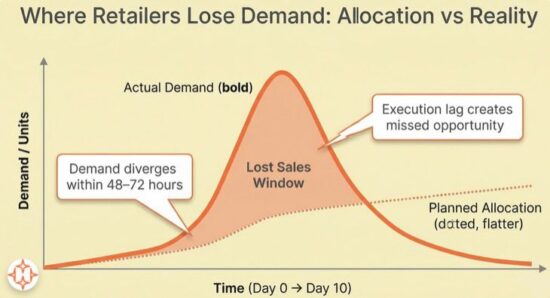
In reality, demand begins diverging within days of launch.
- Store-level demand shifts within 48–72 hours
- A small subset of SKUs drives most of the sell-through
- Demand velocity becomes uneven across locations
As a result, initial allocation decisions become outdated almost immediately once the season begins.
Blind spot 2: Inability to act on demand signals in real time
The breakdown is not in visibility. Demand signals are available. The constraint is the ability to act on them within the same decision window.
Based on our experience working with retail brands at HipHip.AI, most retailers still rely on pre-season retail allocation decisions that assume uniform demand across stores, but lack the ability to respond as demand shifts.
While these constraints are most visible in how retailers respond to demand signals, they often originate from planning assumptions and are amplified by execution delays across the network.
This blind spot is most visible through a set of recurring execution constraints:
| Constraint | What happens in reality | Required shift | Example |
| Static allocation | Top stores stock out in 3–5 days; others hold 20–40% excess | Dynamic reallocation triggered by sell-through variance | A high-demand SKU sells out within days in high-performing stores, while remaining unsold elsewhere |
| Fixed replenishment cycles | Inventory arrives 7–10 days after peak demand | Replenishment triggered within 24–48 hours of demand spike | Replenishment for a fast-selling product arrives after peak demand has passed |
| Store-level inventory lock | Inventory sits idle in low-performing stores | Inter-store transfers executed continuously | Excess inventory remains stuck in low-demand stores instead of moving to stores with active demand |
| Delayed execution | Decisions lag signals by days | Same-day or next-day execution | Sell-through crosses 70%, but allocation updates are implemented only after several days |
Individually, these appear as process inefficiencies. Together, they create measurable financial impact:
- 5–15% lost sales due to stockouts in high-demand stores
- 10–25% excess inventory exposure in slow stores
- 8–20% higher markdown dependency post-season
Retailers don’t lose demand because seasonal forecasting is incorrect. They lose it because they respond too late.
Blind spot 3: Execution latency at the store network level
Even when signals are visible, delays in execution prevent inventory from moving while demand is still active.
Case study
A mid-sized footwear brand operating across ~180 stores entered the festive period with strong pre-season alignment.
Timeline of events:
- Day 3–5: Early spike in specific sizes (UK 7–9)
- Day 5–7: Sell-through crossed 70% in top-performing stores
- Day 7–10: First stockouts in key styles
The signals were visible in reporting dashboards. The constraint was execution:
- Replenishment cycles were fixed at weekly intervals
- Allocation remained locked to initial store plans
- Inter-store transfers required manual approvals and batching
Response lag: 5–7 days
By the time inventory was redirected:
- Peak demand window had already tapered
- Substitute purchases did not fully compensate for lost sales
Business impact:
- Estimated 8–12% revenue loss on top SKUs
- 18–22% excess inventory accumulation across slower stores
- Increased end-of-season markdown pressure
This was not a planning failure. It was a retail store inventory management system that could not compress decision-to-action time.
| Also Read: How Modern Retailers Are Fixing Inventory Replenishment (2026 Guide) |
How execution models are shifting
Execution is moving from periodic planning to continuous response. The shift is operational.
1. Continuous demand tracking
- SKU-store performance is tracked daily or intra-day
- Demand velocity is measured as units/store/day
Alerts triggered when sell-through deviates by ±15–20% vs plan
What changes: Teams move from periodic reviews to exception-based daily action.
2. Dynamic Allocation
Reallocation triggered when:
- Sell-through crosses 60% within the first week
- Stores outperform cluster averages by >20%
High-performing stores receive incremental depth while demand is active
Execution cycle: 24–72 hours
3. Demand-driven replenishment
Replenishment triggered when:
- Days of cover fall below 5–7 days
- Demand velocity accelerates beyond baseline
- Fast-moving SKUs are prioritised in dispatch
What changes: Supply shifts from fixed schedules to demand-led execution.
4. Active inventory repositioning
Transfers triggered when:
- Source stores have >20–25 days of cover
- Destination stores have <5–7 days of cover
Executed multiple times per week or continuously during peak
What changes: Inventory flows across the network, not within store silos.
Enabling real-time retail execution with HipHip.AI
HipHip.AI helps retail brands improve store execution and inventory performance across their store networks. It connects real-time demand signals with execution decisions:
- Identifies stockout risks and excess inventory as demand begins to diverge
- Triggers faster decisions on reallocation, replenishment, and store transfers
- Ensures inventory moves while demand is still active, not after stockouts occur
Beyond inventory, HipHip.AI also supports store operations, visual merchandising compliance, and retail analytics to drive consistent execution across the network.
Closing thoughts
Festive demand exposes the limits of static execution models.
Planning happens once. Demand moves continuously. Execution, in most networks, operates in between.
Inventory decisions can no longer remain fixed once the season begins. They must evolve continuously with demand across stores and SKUs.
These blind spots are not isolated. They compound during high-demand periods, directly impacting sales, inventory balance, and margins.
Execution is no longer just an operational process. It determines whether demand is captured or lost.
In high-velocity retail environments, the ability to act within the same decision window as demand shifts separates growth from missed opportunity.
About HipHip.AI
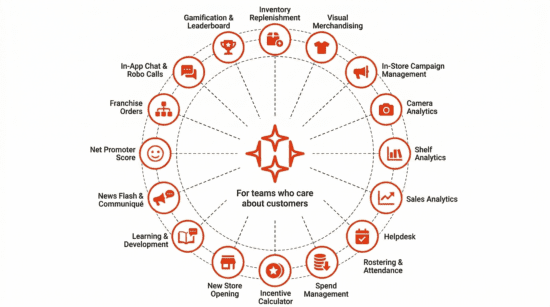
HipHip.AI is an AI-powered, end-to-end retail execution platform used across 10,000+ retail brick and mortar stores. It unifies inventory, merchandising, campaign management, store teams, and store spend into a single operating system—enabling real-time visibility and execution across stores.
Core capabilities include:
- Inventory Replenishment
- Visual Merchandising
- In-Store Campaign Management
- Camera Analytics
- Shelf Analytics
- Sales Analytics
- Helpdesk
- Task Manager
- Rostering & Attendance
- Spend Management
- Incentive Calculator
- New Store Opening
- Learning & Development
- News Flash & Communiqué
- Net Promoter Score
- Franchise Orders
- In-App Chat & Robo Calls
- Gamification & Leaderboard
HipHip.AI integrates seamlessly with existing POS, ERP, WMS, and HRMS systems, ensuring zero disruption to current infrastructure while unlocking smarter, faster retail execution.
Talk to an expert → hiphip.ai
Frequently asked questions
- Why do traditional retail planning models fail during festive seasons?
Traditional models rely on static pre-season forecasts made months in advance. During festivals, demand is highly compressed and diverges at the store-SKU level within 48–72 hours, making initial allocation plans obsolete almost immediately.
- What is the financial impact of poor in-season execution?
Retailers typically face 5–15% lost sales due to stockouts in high-demand areas while simultaneously carrying 10–25% excess inventory in slower locations. This imbalance leads to an 8–20% higher dependency on post-season markdowns.
- How can retailers improve their response time to demand shifts?
The shift requires moving from periodic planning to continuous response. This includes daily SKU-store tracking, dynamic reallocation when sell-through deviates from plans, and demand-driven replenishment cycles that trigger within 24–48 hours.
- What role does technology like HipHip.AI play in inventory management?
Adaptive systems like HipHip.AI bridge the gap between visibility and action by connecting forecasting, allocation, and replenishment into a single decision layer. This ensures inventory is repositioned while demand is still active, rather than after a stockout has already occurred.
- How do retailers decide when to trigger inter-store transfers?
Retailers typically trigger inter-store transfers based on a combination of inventory cover and demand velocity.
Transfers are prioritised when:
- Source stores have excess inventory (e.g., >20–25 days of cover)
- Destination stores are at risk of stockout (e.g., <5–7 days of cover)
- Sell-through rates indicate sustained demand, not short-term spikes
The objective is to ensure inventory is repositioned while demand is still active, without creating unnecessary logistics overhead.
- Does increasing the frequency of inventory movement increase operational costs?
More frequent inventory movement does increase logistics activity, but when executed correctly, it improves overall profitability.
The cost of transfers is typically offset by:
- Higher full-price sell-through in high-demand stores
- Reduction in lost sales due to stockouts
- Lower end-of-season markdowns
Effective systems optimise when and where inventory should move, ensuring that transfers are driven by demand impact rather than volume.
- How long does it take for retailers to shift from static planning to real-time execution?
The transition is typically phased rather than immediate.
Retailers often begin by:
- Introducing daily SKU-store performance tracking
- Piloting dynamic allocation in select categories or regions
- Reducing replenishment cycles for high-velocity SKUs
Initial improvements can be seen within a single season, while full-scale implementation across the network may take multiple cycles depending on system readiness and operational complexity.