


Common mistakes that lead to slow-moving inventory: AI in inventory management
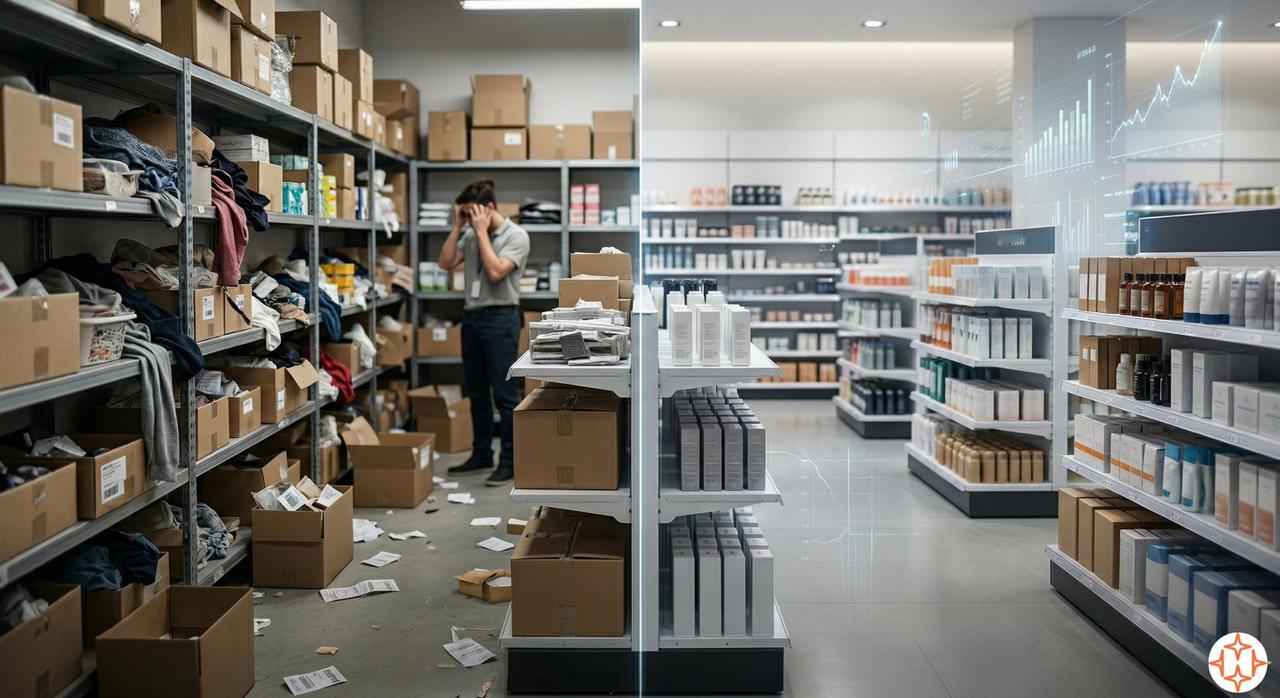
Most retailers believe inventory problems come from bad forecasting.
They don’t.
Inventory enters the season as planned. Forecasts are reasonable. Allocation is aligned.
The failure happens after that.
Demand begins to deviate across stores, and the system does not respond in time.These signals remain within normal variation, not strong enough to trigger action.
They compound. Inventory accumulates and becomes slow-moving. By the time it is visible at a network level, the outcome is already set.
The question is no longer whether this gap exists.
It is how to close it.
Why retailers fail to detect slow-moving inventory early
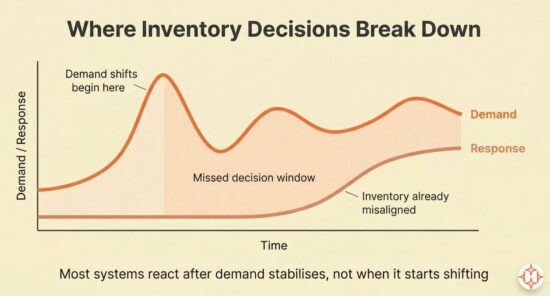
Early signals exist, but they appear as weak and disconnected patterns.
- Slight demand drop at the SKU-store level
- Uneven sell-through across locations
- Stock cover expanding gradually
- Promotions not translating into expected movement
Individually, these signals are easy to ignore. Together, they indicate emerging slow-moving risk.
The limitation is not visibility.
It is the inability to convert these signals into decisions early enough.
This is where AI in inventory management begins to shift the approach from reactive reporting to continuous decision-making.
Traditional systems are not designed to detect this stage.
- Forecasts remain anchored to pre-season plans
- Reports reflect stabilised outcomes, not directional change
- Dashboards show current state, not emerging divergence
These systems require signals to become strong and consistent before they are recognised. They are designed to detect stability, not early-stage deviation.
Rule-based systems rely on fixed thresholds, identifying issues only after predefined limits are crossed.
By the time signals stabilise or thresholds are breached, early-stage risk has already progressed into visible inventory buildup.
They are not built to continuously connect weak signals or translate them into early decisions.
How AI identifies slow-moving and high-risk inventory early
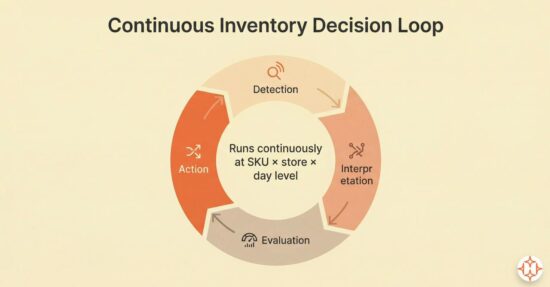
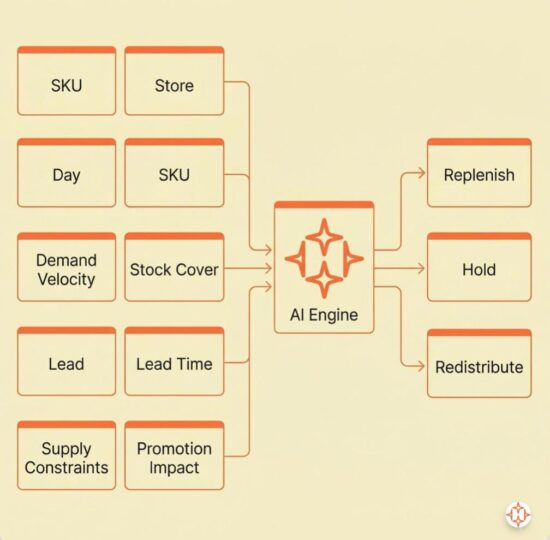
This shift is enabled by granular demand forecasting that operates at the level where divergence actually occurs:
SKU × store × day × demand velocity × stock cover × lead time × supply constraints × promotion impact
In practical terms, this means continuously understanding what is selling, where, how fast, and under what supply and demand conditions, all at once.
At this level, AI operates as a continuous decision system across four layers. These layers work together to detect, interpret, and act on emerging risk.
1. Detection of early divergence
For each SKU in each store, the system establishes a short-term expected movement pattern based on recent sales velocity, store-specific behaviour, and contextual factors such as promotions.
Actual movement is continuously evaluated against this expectation.
Deviation is not treated as a single-point fluctuation.
It is tracked as directional change over multiple days across comparable store clusters.
This allows the system to identify demand shifts while they are still forming, rather than after they stabilise.
Example: A t-shirt selling 18 units per day drops to 14 units per day across similar stores over three days.
2. Interpretation through pattern convergence
Risk is not inferred from a single signal. It emerges from the interaction of multiple weak signals.
A sustained drop in sell-through, combined with rising stock cover and consistent behaviour across similar store clusters, begins to form a pattern.
Individually, these signals remain inconclusive. Together, they indicate early-stage imbalance.
This enables the system to recognise risk before it becomes visible at an aggregated level.
Example: Sell-through declines, stock cover increases from 12 to 16 days, and the same trend appears across comparable stores.
3. Continuous stock cover evaluation
Stock cover is recalculated continuously based on current inventory position, updated demand velocity, and incoming supply.
As demand shifts, stock cover adjusts in real time.
A sustained expansion in stock cover becomes an early indicator of misalignment between inventory and demand.
This ensures that risk is identified not only through sales performance, but through how inventory is behaving relative to expected movement.
Example: Stock cover for a SKU increases from 10 to 18 days within a week as demand slows.
4. Action generation within the same system
Detection and decision-making operate as a single loop.
Once early divergence is identified, the system generates execution-ready actions based on demand velocity, stock cover, and expected movement:
- Rebalancing inventory from slower to faster-moving stores
- Adjusting or pausing replenishment for declining SKUs
- Redirecting incoming supply toward stronger demand locations
- Triggering targeted interventions at the SKU-store level
The system determines whether to replenish, hold, or redistribute inventory based on where demand is expected to materialise and how inventory is currently positioned.
The objective shifts from correcting excess inventory to preventing it from building up.
Example: Replenishment is paused in underperforming stores, and incoming stock is redirected to locations with stable demand.
When these decisions are made continuously at a granular level, the impact extends beyond individual SKUs or stores.
Inventory behaviour across the network begins to shift: from delayed, corrective actions to early, demand-aligned decisions.
| Also read: How Modern Retailers Are Fixing Inventory Replenishment (2026 Guide) |
How AI changes inventory detection and decision-making
When detection and decision-making operate continuously, inventory behaviour shifts in the following ways:
|
Dimension |
Before AI |
After AI |
| Detection timing | Identified after inventory accumulates | Identified during early-stage divergence |
| Signal visibility | Disconnected, low-signal patterns | Connected, pattern-based detection |
| Decision approach | Reactive, based on reports | Continuous, based on emerging signals |
| Action window | Limited, post-accumulation | Extended, while demand is still active |
| Inventory movement | Delayed and corrective | Proactive and demand-aligned |
| Dependence on markdowns | High | Reduced through early intervention |
This improves the ability to detect and respond to inventory risk earlier, reducing the likelihood of excess buildup.
How AI-driven inventory systems differ from erp-based replenishment systems
ERP-based systems operate on predefined planning cycles and fixed logic.
Replenishment decisions are driven by historical data, forecasts, and static rules.
This structure requires signals to stabilise before action is taken.
AI-driven systems operate differently.
Decisions are continuously updated based on real-time demand signals, current inventory positions, and changing conditions across stores and supply.
Detection and execution operate within the same system.
As soon as risk is identified, action is triggered. This includes adjusting replenishment, redistributing inventory, or redirecting supply.
The difference is not just in how decisions are made, but when they are made and whether they can still change the outcome.
Use case
A SKU slows across a subset of stores.
Sell-through declines by 18% over four days, while remaining stable elsewhere.
Stock cover expands from 12 to 19 days. At the same time, 2.5 weeks of inventory is already in transit.
The system pauses replenishment, redirects incoming supply, and rebalances 22% of inventory across stores.
Stock cover stabilises at 13–14 days instead of exceeding 25+ days, avoiding excess buildup and preserving full-price sell-through.
This level of execution requires a system designed for continuous, real-time decisioning.
How HipHip.AI closes the inventory decision gap
HipHip.AI represents this shift in inventory management AI, operating as a continuous decision engine that connects demand signals, inventory behaviour, and supply conditions to drive timely actions across the network.
It continuously evaluates:
- SKU-level sales
- Real-time inventory across stores and warehouses
- Lead times and supply constraints
- Contextual signals such as promotions
Instead of relying on planning cycles or static rules, decisions are updated continuously as demand and inventory conditions evolve.
Detection and execution are not separate steps.
As soon as a shift is identified, the system responds within the same decision window.
Based on emerging signals, it determines:
- What to replenish
- How much to replenish
- When to act
- Whether inventory should be moved from warehouse or across stores
These decisions are not periodic. They are recalibrated continuously, ensuring that inventory remains aligned with actual demand as it shifts.
The result is a system that does not wait for problems to become visible. It operates while they are still forming, when intervention can still change the outcome.
Conclusion
Slow-moving inventory is not the problem. It is the point at which delayed decisions become visible.
The advantage lies in acting earlier, when signals are still forming and outcomes can still be shaped.
This is where inventory decisions shift from correction to prevention.
Frequently asked questions
- Why do retailers fail to identify slow-moving inventory early?
Retailers fail to identify slow-moving inventory early because early signals appear weak and fragmented at the SKU-store level. Small drops in demand, uneven sell-through, and gradual increases in stock cover are often treated as normal variation.
Traditional systems are designed to detect stable patterns or threshold breaches, not early-stage deviation. As a result, risk is only recognised after inventory has already accumulated.
- How can retailers detect misaligned inventory across store clusters?
Misaligned inventory can be detected by comparing SKU performance across similar store clusters rather than evaluating stores in isolation.
AI systems track relative sell-through, demand velocity, and stock cover across comparable locations. When a SKU underperforms in a subset of stores while performing normally elsewhere, it indicates early misalignment that requires intervention.
- How does AI improve slow-moving inventory detection compared to rule-based systems?
Rule-based systems rely on fixed thresholds, identifying issues only after predefined limits are crossed.
AI systems continuously track directional changes in demand and inventory behaviour. They detect early divergence across SKUs and stores before thresholds are breached, enabling earlier and more precise identification of slow-moving risk.
- What types of AI models are used for SKU-level demand sensing?
AI-driven systems typically use short-term demand sensing models that continuously update expected movement based on recent sales trends, store-specific behaviour, and contextual signals such as promotions.
These models focus on near-term demand estimation rather than long-term forecasting, allowing the system to detect changes in demand patterns as they emerge.
- What accuracy improvements can AI deliver in inventory risk prediction?
AI improves the ability to identify inventory risk earlier rather than simply improving point-in-time accuracy.
By continuously tracking demand and stock behaviour, AI systems detect emerging risk before it becomes visible, reducing the likelihood of excess inventory buildup and improving overall decision accuracy across the network.
- How does AI decide when to replenish, hold, or redistribute inventory?
AI evaluates demand velocity, stock cover, and expected future movement at the SKU-store level.
Based on these signals, it determines whether inventory should be replenished, held, or redistributed across stores. The objective is to maintain optimal stock levels while preventing excess accumulation and ensuring inventory is positioned where demand is expected.
- What competitive advantage does AI-driven inventory optimization provide?
AI-driven inventory optimization enables earlier detection of demand shifts, allowing retailers to act before problems become visible.
This leads to better demand capture, improved inventory balance across stores, and reduced dependence on markdowns, ultimately improving margins and operational efficiency.
- How does AI handle SKU-store level complexity in large retail networks?
AI systems operate at a granular level, evaluating inventory across thousands of SKUs and stores simultaneously.
By analysing SKU × store × day data, they manage complexity without relying on aggregated assumptions, ensuring decisions are aligned with actual demand patterns across the network.