


Why your replenishment system is failing (And what retailers are doing instead): 2026 guide

Inventory replenishment used to be predictable.
Retailers would forecast demand at the beginning of a season, allocate inventory across stores, and then replenish stock periodically based on sales reports. The system worked reasonably well when product cycles were slower and demand patterns were more stable.
Retail today is very different.
Demand now shifts rapidly across cities, malls, and online channels. A product can go viral overnight. Regional preferences vary widely. A sneaker that sells out in a university district may sit unsold in a corporate district. Promotions, festivals, and social media trends can create sudden spikes in demand.
In most multi-store retail networks we observe the same pattern repeatedly. Shelves go empty for the products customers want, while excess inventory accumulates elsewhere in the network.
This is not a supply problem. It is a replenishment problem.
The issue is not how much inventory retailers have. It is how slowly decisions respond to what is happening in stores.
This guide explains how leading retailers are fixing inventory replenishment and what the modern replenishment system looks like in 2026.
Why traditional inventory replenishment breaks
In most retail networks, replenishment still follows a basic planning cycle which looks structured on paper, but several structural problems appear once a retailer operates hundreds of stores.
| Challenge | What really happens in practice? |
| Static forecasts | • Forecasts are created before the season begins
• Forecasts remain largely unchanged after inventory allocation • Demand shifts are not reflected in updated forecasts |
| Uniform allocation | • Inventory is distributed evenly across stores
• Allocation decisions rely on broad demand assumptions • Local store demand differences are ignored |
| Slow decision cycles | • Replenishment decisions reviewed weekly or less frequently
• Adjustments made only after noticeable sales changes • Operational response is delayed |
| Limited store-level intelligence | • Demand analyzed at an aggregate level
• SKU performance per store is not deeply analyzed • Local demand patterns remain hidden |
When these limitations combine, retailers face the same outcome repeatedly.
Some stores run out of high-demand products while other stores hold excess inventory that moves slowly.
The difference between traditional and modern replenishment systems becomes clearer when we compare how decisions are made and executed.
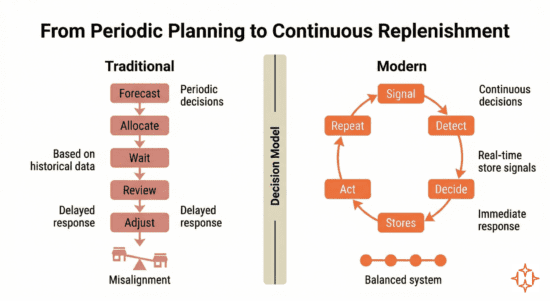
In traditional systems, inventory decisions follow reporting cycles. In modern systems, they follow demand signals.
How inventory decisions actually flow in modern retail
In large retail networks, inventory performance is not determined by how much stock is available. It is determined by how quickly decisions respond to what is happening at the store level.
At any given moment, multiple demand signals are shifting:
- Sales velocity changes across stores
- Certain SKUs begin moving faster in specific locations
- Promotions or local events trigger sudden spikes
- Some stores start accumulating slow-moving inventory
These changes often emerge within hours or days—not weeks.
Each of these shifts requires immediate decisions:
- Which stores need replenishment now
- Which stores should not receive additional stock
- Where inventory should be reallocated
- Whether initial allocations need correction
In most retail setups, these decisions are not made when the change occurs. They are reviewed periodically, after the shift has already impacted sales.
Execution adds another layer of delay.
Even when the right decision is identified, timing determines whether it still matters:
- Replenishment must arrive before stockouts
- Transfers must happen while demand is active
- Allocation changes must happen early in the product lifecycle
If action follows too late, the opportunity is already lost.
This creates a consistent pattern across retail networks:
- Signals are visible
- Decisions are delayed
- Execution follows after the delay
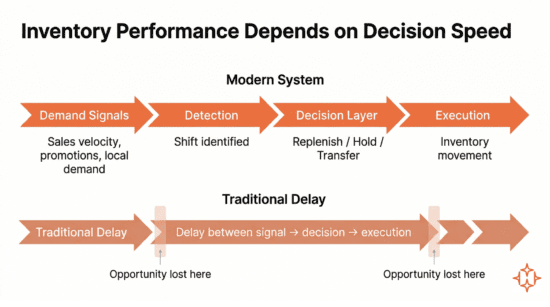
As a result, inventory remains misaligned with demand, even when total stock is sufficient.
What’s missing is not better reporting or more visibility.
What’s missing is a system that continuously converts these signals into decisions and execution.
This is where modern replenishment systems operate differently.
They do not rely on periodic planning cycles.
They operate as continuous decision systems, where:
- Store-level signals are captured in real time
- Demand changes are detected immediately
- Decisions are updated continuously
- Inventory movement is triggered without delay
This model shows up in how modern systems handle specific inventory challenges:
- Store-level demand prediction
- Smarter allocation for new product launches
- Event-driven replenishment
- Real-time inventory visibility
- Intelligent inventory transfers between stores
- AI-driven replenishment optimization
Let’s look at how each of these capabilities works in practice and why they are becoming essential for large retail networks.
Store-level demand prediction
Retail demand varies significantly between locations. Store size, customer demographics, nearby businesses, and local events all influence how products perform in each store.
Example:
Consider a sportswear retailer selling a running shoe model across 120 stores.
Initial inventory allocation distributes 40 units of the shoe to each store. Within the first two weeks, sales data reveals very different demand patterns:
| Store Location | Weekly Sales Velocity | Remaining Stock After 2 Weeks |
| University district store | 18 units per week | Almost sold out |
| Corporate district store | 6 units per week | Large remaining stock |
| Mall flagship store | 14 units per week | Moderate remaining stock |
In many retail networks we see demand patterns diverge within just a few days of launch.
If the retailer relies on the original allocation plan, the university store will run out of stock within days, while the corporate district store will continue holding excess inventory.
A modern forecasting system detects these differences early by analyzing point-of-sale data.
The system updates demand predictions for each store:
- The university district store receives higher replenishment quantities.
- The flagship mall store receives moderate replenishment.
- The corporate district store receives minimal replenishment until its existing inventory starts moving.
In some cases, the system may even recommend transferring inventory from slower stores to faster ones to prevent stockouts.
By adjusting replenishment decisions based on store-level demand patterns, retailers can significantly improve product availability while reducing excess inventory across the network.
Smarter Allocation for New Product Launches
When a new SKU is introduced, there is little or no historical data to guide allocation decisions. Many retailers respond by distributing inventory evenly across stores.
This approach rarely works well as some stores sell out quickly because demand is strong, while other stores struggle to sell the product because the customer base is different.
Modern retailers address this challenge using predictive allocation models. Instead of relying on equal distribution, these systems analyze historical sales data from similar products, evaluate store-level demand patterns, and estimate which stores are most likely to generate strong demand for the new SKU.
Example:
Imagine the same sportswear retailer is launching a new running shoe model across its 120-store network.
A traditional allocation strategy might distribute the initial inventory equally across stores.
| Store Location | Initial Allocation (Traditional Method) |
| University district store | 40 units |
| Corporate district store | 40 units |
| Mall flagship store | 40 units |
Within the first week, demand patterns start to emerge:
- The university district store sells 25 pairs quickly due to strong demand from student runners.
- The mall flagship store sells 18 pairs due to higher footfall.
- The corporate district store sells only 7 pairs.
This means the university store may run out of stock within days, while the corporate district store still holds excess inventory.
Modern predictive allocation systems approach this differently.
Instead of distributing inventory evenly, the system analyzes historical data from similar running shoe launches. It evaluates factors such as:
- historical demand patterns for similar SKUs
- store-level sales velocity
- customer demographics around each store
- regional demand for athletic footwear
Based on this analysis, the system might recommend a more targeted allocation like this:
| Store Location | Predicted Demand | Recommended Allocation |
| University district store | High | 70 units |
| Mall flagship store | Medium | 50 units |
| Corporate district store | Low | 25 units |
This smarter allocation ensures that the stores most likely to sell the product receive more inventory from the beginning.
As real sales data begins to arrive, the replenishment system continues to adjust allocations, ensuring that high-demand stores remain stocked while slower stores do not accumulate excess inventory.
By combining predictive allocation with continuous demand monitoring, retailers can significantly improve launch performance and reduce the risk of early stockouts.
Event-driven replenishment
Retail demand does not follow a smooth curve throughout the year.
Demand spikes during holidays, promotional campaigns, and seasonal events. Social media trends can also accelerate demand unexpectedly.
A traditional replenishment system may not react quickly enough to these changes.
Modern systems monitor demand signals continuously and detect unusual changes in sales velocity. When the system detects an event-driven spike, replenishment decisions are adjusted immediately.
Example:
A fashion retailer runs a weekend promotion across select cities.
Within the first day, demand for a specific SKU increases sharply in 20 stores located in high-footfall areas. At the same time, the same SKU continues to move slowly in several other stores.
In a typical setup, this change becomes visible only after periodic sales reviews. By the time replenishment decisions are made and inventory is moved, many of the high-demand stores have already run out of stock.
As a result:
- Sales are lost during peak demand
- Customers switch to alternatives or competitors
- Excess inventory remains in slower stores
The total inventory across the network is sufficient, but it is not positioned where demand exists at that moment.
Inventory can be redirected to stores experiencing higher demand, ensuring shelves remain stocked during critical sales periods.
This ability to respond to real-time demand signals is a major advantage of modern replenishment systems.
Real-time inventory visibility
Accurate replenishment decisions require visibility across the entire inventory network.
Retailers must understand how much inventory exists in warehouses, distribution centers, and individual stores.
Modern platforms provide real-time visibility into inventory positions across the entire network. Retail leaders can quickly identify slow-moving SKUs, potential stockouts, and stores holding excess inventory.
This transparency allows planners to intervene early and prevent problems before they affect sales.
Intelligent inventory transfers between stores
Historically, replenishment decisions focused primarily on moving inventory from warehouses to stores.
Modern retailers increasingly rely on store-to-store transfers as well.
If one store has excess stock while another store faces rising demand, transferring inventory between those stores can be faster and more efficient than waiting for warehouse replenishment.
Modern replenishment systems automatically identify these transfer opportunities and recommend actions that improve product availability.
This approach improves sell-through and reduces the need for markdowns.
Conclusion
Modern replenishment systems combine store-level demand forecasting, real-time inventory visibility, and AI-driven allocation to ensure the right products reach the right stores at the right time.
In practice, the difference comes down to execution speed.
Retailers that respond earlier to demand shifts are able to maintain availability, reduce excess inventory, and improve sell-through across stores.
About HipHip.AI
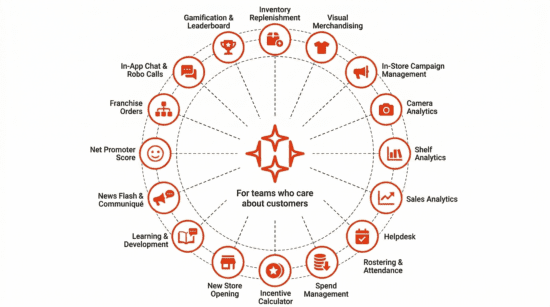
HipHip.AI is an AI-powered, end-to-end retail execution platform used across 10,000+ retail brick and mortar stores. It unifies inventory, merchandising, campaign management, store teams, and store spend into a single operating system—enabling real-time visibility and execution across stores.
Core capabilities include:
- Inventory Replenishment
- Visual Merchandising
- In-Store Campaign Management
- Camera Analytics
- Shelf Analytics
- Sales Analytics
- Helpdesk
- Task Manager
- Rostering & Attendance
- Spend Management
- Incentive Calculator
- New Store Opening
- Learning & Development
- News Flash & Communiqué
- Net Promoter Score
- Franchise Orders
- In-App Chat & Robo Calls
- Gamification & Leaderboard
HipHip.AI integrates seamlessly with existing POS, ERP, WMS, and HRMS systems, ensuring zero disruption to current infrastructure while unlocking smarter, faster retail execution.
Talk to an expert → hiphip.ai
Frequently asked questions
What is inventory replenishment in retail?
Inventory replenishment in retail refers to the process of restocking products in stores based on demand signals, sales data, and inventory levels. Modern replenishment systems use real-time sales data and demand forecasting to ensure that the right products are available in the right stores at the right time.
How do large retail chains decide how much inventory to send to each store?
Most modern retailers use demand forecasting tools like HipHip.ai that analyze historical sales, store performance, and product attributes to estimate demand for each store. Instead of distributing inventory evenly, these systems allocate more stock to high-demand locations and less to slower stores.
Can retailers move inventory between stores instead of always replenishing from warehouses?
Yes. Many retailers now use store-to-store transfers as part of their replenishment strategy. If one store has excess inventory while another store is running out of stock, transferring inventory between locations can be faster than waiting for warehouse replenishment.
How do retailers predict demand for a completely new product with no sales history?
Retailers typically analyze historical sales from similar products, store demand patterns, and regional preferences to estimate demand for new SKUs. Modern systems can use machine learning models to improve these predictions and adjust allocation as real sales data starts coming in.
How does HipHip.AI help retailers improve inventory replenishment?
HipHip.AI helps retail teams monitor inventory performance across their store network and identify stockout risks or slow-moving inventory early. By combining real-time store signals with demand insights, the platform helps retailers make smarter replenishment and allocation decisions.
Related reads
- The hidden visibility gaps that quietly break your replenishment system
- Why most forecasts fail at the store level—and how to fix it
- The real logic behind allocating new SKUs across stores
- How retailers avoid overstocking and stockouts during peak seasons
- What early risk signals look like at SKU and store level